KS Learning can provide extra lessons for maths from gcse maths tutors in London and help with gcse maths past papers, gcse maths revision notes, and gcse maths revision worksheets. Maths private tuition at its tuition centre can improve maths knowledge and performance through maths lessons, mathematics tutorials and maths tuition Twickenham.
| graph | equation | conditions |
|---|---|---|
| straight line | \(y = x \) | none |
| quadratic | \(y = x^2 \) | none |
| cubic | \(y = x^3 \) | none |
| quartic | \(y = x^4 \) | none |
| straight line | \(y = - x \) | none |
| quadratic | \(y = - x^2 \) | none |
| cubic | \(y = - x^3 \) | none |
| quartic | \(y = - x^4 \) | none |
| half quadratic | \( y = { \sqrt{x}} \) | none |
| quadratic | \( y = {\pm \sqrt{x}} \) | none |
| hyperbola | \( y = \frac{1}{x} \) | asymptotes \( x = 0 \) and \( y = 0 \) |
| hyperbola | \(xy = a \) | asymptotes \( x = 0 \) and \( y = 0 \) |
| hyperbola | \( y = - \frac{1}{x} \) | asymptotes \( x = 0 \) and \( y = 0 \) |
| hyperbola | \(xy = - a \) | asymptotes \( x = 0 \) and \( y = 0 \) |
| quadratic | \(y = ax^2 + bx + c \) | none |
| quadratic | \(y = - ax^2 + bx + c \) | none |
| quadratic | \(y = (x - a)(x - b) \) | none |
| cubic | \(y = ax^3 + bx^2 + cx + d \) | none |
| cubic | \(y = (x - a)(x - b)(x - c) \) | none |
| circle | \( x^2 + y^2 = r^2 \) | none |
| circle | \( (x - a)^2 + (y - b)^2 = r^2 \) | none |
| ellipse | \( \frac{x^2}{a^2} + \frac{y^2}{b^2} = 1 \) | none |
| exponential | \(y = a^x \) | asymptote \( y = 0 \) |
| logarithmic | \(y = log(x) \) | asymptote \( x = 0 \) |
Consider the following equation
\(y = 3x^2 - 6x + 5 \)
Factorise the coefficient of \(x^2 \) from the \(x^2 \) term and \(x \) term, in this case 6. Use square brackets to avoid confusion later.
\(y = 3[x^2 - 2x] + 5 \)
Divide the coefficient of \(x \) by 2, in this case -2, and use it to write it inside round brackets that are squared with \(x \).
\(y = 3[(x - 1)^2 \) ...
Subtract the number inside the brackets, square the number, and close the square brackets.
\(y = 3[(x - 1)^2 -(-1)^2] \) ...
Carry down the number on the end of the orignal equation, in this case +5.
\(y = 3[(x - 1)^2 -(-1)^2] + 5 \)
Square the number inside the square brackets, in this case -1.
\(y = 3[(x - 1)^2 -1] + 5 \)
Multiply through by the number outside the square brackets.
\(y = 3(x - 1)^2 -3 + 5 \)
And add the numbers at the end of the equation.
\(y = 3(x - 1)^2 + 2 \)
The job is done!
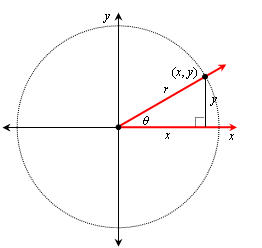 \( sin(x) = \frac{y}{r} \)
\( cos(x) = \frac{x}{r} \)
\( tan(x) = \frac{y}{x} \)
\( sec(x) = \frac{r}{x} \)
\( cosec(x) = \frac{r}{y} \)
\( cot(x) = \frac{x}{y} \)
\( sec(x) = \frac{1}{cos(x)} \)
\( cosec(x) = \frac{1}{sin(x)} \)
\( cot(x) = \frac{1}{tan(x)} \)
\( tan(x) = \frac{sin(x)}{cos(x)} \)
\( cot(x) = \frac{cos(x)}{sin(x)} \)
\( cos^2(x) + sin^2(x) = 1 \)
\( 1 + tan^2(x) = sec^2(x) \)
\( 1 + cot^2(x) = cosec^2(x) \)
\( \frac{d}{dx} (sin(x)) = cos(x) \)
\( \frac{d}{dx} (cos(x)) = -sin(x) \)
\( \frac{d}{dx} (tan(x)) = sec^2(x) \)
\( \frac{d}{dx} (sec(x)) = sec(x)tan(x)\)
\( \frac{d}{dx} (cosec(x)) = -cosec(x)cot(x) \)
\( \frac{d}{dx} (cot(x)) = -cosec^2(x) \)
\( sin(A + B) = sin(A)cos(B) + sin(B)cos(A) \)
\( sin(A - B) = sin(A)cos(B) - sin(B)cos(A) \)
\( cos(A + B) = cos(A)cos(B) - sin(A)sin(B) \)
\( cos(A - B) = cos(A)cos(B) + sin(A)sin(B) \)
\( tan(A + B) = \frac{tan(A) + tan(B)}{1 - tan(A)tan(B)} \)
\( tan(A - B) = \frac{tan(A) - tan(B)}{1 + tan(A)tan(B)} \)
\( sin(2A) = 2sin(A)cos(B) \)
\( cos(2A) = cos(A)^2 - sin(A)^2 \)
\( cos(2A) = 2cos(A)^2 - 1 \)
\( cos(2A) = 1 - 2sin(A)^2 \)
\( tan(2A) = \frac{2tan(A)}{1 - tan(A)^2} \)
Maths makes use of the following symbols and terms
| Symbol | Meaning |
|---|---|
| = | equal to |
| ≡ | equivalent to |
| ≠ | not equal to |
| < | less than |
| > | greater than |
| ≤ | less than or equal to |
| ≥ | greater than or equal to |
| ∼ | tilde operator |
| ≈ | approximately equal to |
| ∑ | the sum of (greek capital letter sigma) |
| α | greek small letter alpha |
| β | greek small letter beta |
| γ | greek small letter gamma |
| δ | greek small letter delta |
| ε | greek small letter epsilon |
| ζ | greek small letter zeta |
| η | greek small letter eta |
| θ | greek small letter theta |
| λ | greek small letter lambda |
| μ | greek small letter mu |
| ν | greek small letter nu |
| π | reek small letter pi |
| ρ | greek small letter rho |
| σ | greek small letter sigma |
| τ | greek small letter tau |
| φ | greek small letter phi |
| χ | greek small letter chi |
| ψ | greek small letter psi |
| ω | greek small letter omega |
| Φ | greek capital letter phi |
| Χ | greek capital letter chi |
| Ψ | greek capital letter psi |
| Ω | greek capital letter omega |
| ∈ | element of |
| ∉ | not an element of |
| ∏ | product sign |
| ∫ | integral |
| ∞ | infinity |
| ∴ | therefore |
| ⇒ | therefore |
| Sum | the result of adding |
| Difference | the result of substracting |
| Product | the result of multiplying |
Prefixes are added to the base unit so 9Gm (giga metres) means 9 x 10⁹ m = 9 000 000 000 m
| Index | Symbol | Name |
|---|---|---|
| 1012 | T | tera |
| 109 | G | giga |
| 106 | M | mega |
| 103 | k | kilo |
| 102 | h | hecto |
| 101 | da | deca |
| base unit | ||
| 10-1 | d | deci |
| 10-2 | c | centi |
| 10-3 | m | milli |
| 10-6 | µ | micro |
| 10-9 | n | nano |
| 10-12 | p | pico |
A good tutor can build the confidence of a learner enabling subject success
A private tutor can improve the skills a pupil needs to master a subject
Regular tutoring can drive progress and better results in school subjects
Support can help students and parents make the right academic decisions