KS Learning can provide extra lessons for maths from gcse maths tutors in London and help with gcse maths past papers, gcse maths revision notes, and gcse maths revision worksheets. Maths private tuition at its tuition centre can improve maths knowledge and performance through maths lessons, mathematics tutorials and maths tuition Twickenham.
| Question | Answer |
|---|---|
| Name the two types of microscopes. | light microscopes and electron microscopes |
| Name the two types of electron miscroscopes. | scanning and transmission electron microscopes |
| State the characteristics of a light microscope. |
• uses light to create an image • magnifies up to 2000 times • is relatively cheap • can use live specimens • produces images in colour |
| State the characteristics of a transmission electron microscope. |
• uses electrons to produce an image • magnifies up to 2 000 000 times • specimens are placed in a vacuum so dead • produces a 2D image • image is not in colour • is very expensive |
| State the characteristics of a scanning electron microscope. |
• uses electrons to produce an image • magnifies up to 2 000 000 times • specimens are placed in a vacuum so dead • produces a 3D image • image is not in colour • is very expensive |
| State the formula for magnification. | magnification = size of image divided by size of real object |
| Explain resolution | the ability to distinguish between two separate points |
| What does resolving power determine? | it affects how much detail can be seen in the image |
| What is the basic unit of living organisms? | the cell |
| Name the two groups of cells. | eukaryotic and prokaryotic cells |
| What is a unicellular organism? | an organism that consists of a single cell |
| What is a multicellular organism? | an organism that is made from more than one cell |
| What is a prokaryotic cell? | a cell without a nucleus |
| What is a eukaryotic cell? | a cell with a nucleus |
| Name two of the types of eukaryotic cells. | plant and animal cells |
| What is a single cell organism called? | a unicellular organism |
| Question | Answer |
|---|---|
| What is the average size of an animal cell? | 10 to 30 micrometers; a micrometer is a millionth of a metre |
| Name the organelles shared by animal and plant cells. | a nucleus, cytoplasm, cell membrane, mitochondria, ribosomes |
| Name the additional organelles in plant cells. | chloroplasts, a cell wall, a permanent vacuole |
| Can animal cells contain a vacuole? | Yes, some animal cells contain a vacuole but vacuoles are temporary in animals. |
| What is in the nucleus? | the chromosomes |
| What is the role of the nucleus? | it controls the cell and contains the chromosomes |
| What is the role of the cytoplasm? | a jelly-like substance that fills the cell and is where the chemical reactions take place in the cell |
| What is metabolism? | All the chemical reactions that take place in an organism are referred to as the metabolism |
| What is the role of the cell membrane? | surrounds the cell and allows substances in and out the cell |
| What is the role of the mitochondria? | the location for aerobic respiration which releases energy from food |
| What is the role of the ribosome? | the location for protein synthesis |
| What is the role of the cell wall? | to provide support for plants which do not have bones |
| What is the role of the chloroplast? | contains the green chemical chlorophyll that absorbs light so the plant can make food by photosynthesis |
| What is the role of the vacuole? | keeping the cell rigid and storage |
| What is photosynthesis? | using light, carbon dioxide and water to make glucose for food |
| What do genes do? | genes carry the instructions for making proteins |
| Name 2 substances that move out the cell? | urea and carbon dioxide |
| Name 2 substances that move into the cell? | glucose and mineral ions |
| What is respiration? | The process that releases energy. It takes place in the mitochondria |
| Where are proteins made? | in the ribosomes |
| What kingdom do algae belong to? | the protista. They do NOT belong to the plant kingdom. |
| What is the cell wall made of in plant cells? | cellulose |
| Why are chloroplasts green? | Because they contain chlorophyl and chlorophyl is green |
| Question | Answer |
|---|---|
| What kingdoms are eukaryotes? | animals, plants, fungi, protista |
| Give an example of a prokaryote | bacteria |
| How can one identify a eukaryotic cell? | it has a cell membrane, a cytoplasm, and a nucleus containing chromosomes |
| How can one identify a prokaryotic cell? | it has a cell membrane, and a cell wall but no nucleus |
| What is DNA? | It is a special chemical from which genetic material like chromosomes and plasmids are built. |
| Where is the genetic material in a eukaryotic cell? | It is in the nucleus organised into chromosomes made of DNA |
| Where is the genetic material in a prokaryotic cell? | It floats in the cytoplasm usually as a single loop. Some prokaryotic cells have extra small rings of DNA called plasmids. |
| Which cell type is larger? | Eukaryotic cells are larger than prokaryotic cells |
| What is the size of a bacterium? | Bacteria are very small, between 0.2 and 2 micrometers |
| Is the cell wall of a bacterium the same as the cell wall of a plant cell? | No, the cell wall of a bacterium is not made of cellulose |
| What features do all bacteria share? | They have a cell wall, a cell membrane, cytoplasm and genetic material |
| What additional features may bacteria have? | a slimy capsule for protection; flagella for movement |
| Are bacteria harmful? | Most are not harmful at all and some are even useful but a small number can cause diseases and some of these diseases are deadly |
| What affect do bacteria have on food? | They cause it to decompose (rot) |
| What do we call a group of bacteria? | a colony of bacteria |
| What shape are bacteria? | They come in lots of different shapes like spheres and rods |
| What is meant by culturing bacteria? | It means to grow bacteria usually in a substance called agar |
| What are flagella made from? | proteins |
| Question | Answer |
|---|---|
| Why do cells differentiate? | to be able to carry out different functions |
| What is a specialised cell? | a cell that has differentiated to perform a single function |
| Name three specialised animal cells | nerve cell, muscle cell, and sperm cell |
| What does a nerve cell do? | it carries electrical impulses around the body of an animal |
| What are the advantages of nerve cells? | they provide fast communication between different parts of the body |
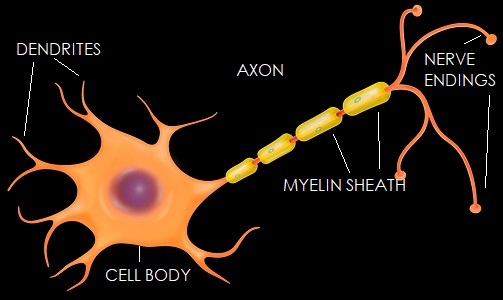
| Name the parts of a nerve cell | nucleus in the cell body, dendrites on the cell body, a long axon with a myelin sheath, and nerve endings or synapses at the end of the cell
|
| What do dendrites do? | the dendrites make connections to other cells to receive signals from them |
| What does the axon do? | it carries the impulse from one end of the nerve to the other end |
| What do the nerve endings do? | the nerve endings or synapses pass impulses to other nerve cells or muscles using special chemicals |
| Where are there lots of mitochondria in the nerve cell? | in the synapses to provide the energy to make transmitter chemicals |
| What do muscle cells do? | they are specialised to contract and relax |
| Name the two types of muscle tissue found in the human body? | smooth and striated muscle tissue |
| Where is smooth muscle found? | in the internal organs |
| Where is striated muscle found? | attached to the skeleton |
| What movement is done by smooth muscle? | involuntary movement |
| State a location in the human body where smooth muscle tissue can be found. | smooth muscle surrounds the gut where it squeezes the food through it |
| What movement is done by striated muscle? | voluntary movement |
| How do striated muscles work to move the bones? | muscles contract and relax in pairs to move the bones of the skeleton |
| State a location in the human body where striated muscle tissue can be found. | biceps of the arm |
| Name the adaptations of striated muscle. | they contain special proteins, many mitochondria, and store glycogen |
| What do the special proteins do in striated muscles? | they slide over each other to make the muscle contract |
| Why does striated muscle contain many mitchondria? | to produce the energy needed to make the muscle contract and relax |
| Why does striated muscle store glycogen? | glycogen can be broken down and used in respiration by the mitochondria to produce energy for muscle contraction |
| What does a sperm cell do? | it fertilises the egg with the genetic information from the male parent |
| List the adaptations that enable a sperm cell to do its task | a long tail, a middle section with mitochondria, an acrosome, and a large nucleus |
| What is the purpose of the sperm's long tail? | the tail makes it possible for sperm cells to travel through water or the female reproductive system |
| Name the 3 parts of the sperm cell. | the head, the midpiece, the tail |
| What does the midpiece contain and why? | the midpiece, it is full of mitochrondria which generate the energy that makes it possible for the sperm cell to move |
| What is the role of the acrosome? | it stores the digestive enzymes needed to break down the outer layers of the egg |
| What does the nucleus in a sperm cell do? | it contains the genetic information from the male parent to be passed to offspring |
| Question | Answer |
|---|---|
| Name 4 specialised plant cells | root hair cells, photosynthesis cells, xylem cells, phloem cells |
| Where are root hair cells found? | close to the tips of growing roots |
| What is the job of root hair cells? | they enable plants to take up water and mineral ions efficiently |
| How do mineral ions get into the root hair cells? | mineral ions are moved in by active transport |
| List the three main adaptations of root hair cells | increased surface area, large permanent vacuole, many mitochondria |
| How does the root hair cell increase its surface area? | the extension 'hair' from the cell increases the surface area |
| Why does the root hair cell need a large surface area? | to maximise the water that the roots absorb |
| What is the role of the large permanent vacuole in the root hair cell? | to speed up the movement of water by osmosis into the root hair cell |
| Why does the root hair cell have many mitochondria? | to provide the energy for the active transport of mineral ions into the root hair cell |
| Can all plant cells perform photosynthesis? | No. Lots of plant cells cannot carry out photosynthesis. |
| List the adaptations of photosynthetic plant cells | they contain chloroplasts, are positioned in continuous layers, and contain a large permanent vacuole |
| What do chloroplasts do? | chloroplasts contain the green chemical chlorophyll that traps light for photosynthesis |
| Where are photosynthetic plant cells positioned? | close to the surface of leaves and stems to absorb as much light as possible |
| What is the role of the large permanent vacuole? | it helps to keep the cell rigid by osmosis |
| What is photosynthetic tissue? | lots of photosynthetic cells arranged together |
| What is the role of photosynthetic tissue? | they help support the stem and keep the leaf spread out so that can collect as much light as possible |
| What is xylem? | it is the transport tissue that carries water and mineral ions from the roots to the leaves and shoots |
| What is xylem made of? | dead xylem cells joined end to end |
| How are xylem adapted? | they form long tubes and are strengthened by spirals and rings of lignin |
| How is xylem formed? | • xylem cells start out alive • as they grow lignin builds up in spirals on the cell wall • then they die losing their ends to form long hollow tubes |
| What is the role of the lignin spirals and rings? | it makes them strong enough to withstand the pressure of water moving up the xylem and to help support the stem |
| What is the role of phloem? | it is the transport tissue that carries the food made by photosynthesis around the plant |
| What is the structure of phloem? |
• made of phloem cells • the cells form tubes • they do not become lignified • they are alive • they have sieve plates either end of the cells |
| List the adaptations of phloem cells | special sieve plates and reduced internal structures |
| Where are the sieve plates? | between the connected cell walls of phloem cells forming a tube |
| How do the sieve plates form? | the cell wall breaks down in places to form multiple holes |
| Why could phloem cells not stay alive on their own? | because they lose a lot of their internal structures to create space for solutions of food to travel through them |
| How are phloem cells kept alive? | they are supported by companion cells |
| Where do phloem cells get the energy to move dissolved food up and down the phloem? | the mitochondria of the companion cells transfer energy to the phloem cell to enable the movement of dissolved food |
| List the differences between phloem and xylem |
• phloem is alive and xylem is dead • phloem can transport both ways and xylem can only • phloem cells transport food and xylem cells transport water and mineral ions |
| Question | Answer |
|---|---|
| How does oxygen move into cells? | by diffusion |
| What is diffusion? | the net movement of particles from an area of high concentration to an area of low concentration |
| What is meant by 'the net movement of particles'? | in diffusion particles move both ways - the net movement is the difference between the particles moving in and the particles moving out |
| In what phases of matter does diffusion occur? | in gases and liquids |
| Why does diffusion happen? | because the particles in a gas and a liquid are in constant random movement they will spread out gradually helped by bumping into each other |
| Name the factors that affect diffusion | concentration, pressure, temperature, and surface area |
| How does concentration affect diffusion? | the greater the difference in concentration between two areas, the faster the rate of diffusion |
| What is the concentration gradient? | the difference between two areas of concentration |
| What is the relationship between diffusion and the concentration gradient? |
• diffusion occurs down a concentration gradient • the higher the concentration gradient, the faster the diffusion |
| How does temperature affect diffusion? | an increase in temperature will increase the rate of diffusion |
| Why does temperature affect diffusion? | an increase in temperature makes the particles move quicker so increases the rate of diffusion |
| What is the main advantage of diffusion? | it does not require energy |
| What is the main disadvantage of diffusion? | it is very slow relatively speaking |
| How do dissolved substances move in and out of the cell? | they move in and out the cell across the cell membrance by diffusion |
| List some substances that move in and out the cell by diffusion | simple sugars like glucose, gasses like oxygen and carbon dioxide, waste products like urea |
| Where does urea come from? | urea is a waste product from the conversion of amino acids to carbohydrates in the liver |
| What do the kidneys do? | they extract urea from the blood plasma for excretion via the bladder |
| Why does the body need oxygen? | for aerobic respiration which is much more efficient than anaerobic respiration |
| What is the difference between aerobic respiration and anaerobic respiration? | • aerobic respiration uses oxygen to get energy from food like glucose and anaerobic respiration does not • aerobic respiration produces a lot more energy from each molecule of glucose than anaerobic respiration |
| How does oxygen reach the cells of the body? | • oxygen moves from the air in the lungs into the red blood cells down a concentration gradient by diffusion • oxygen then moves from the red blood cells into the cells down a concentration gradient by diffusion |
| What is gas exchange? | the diffusion of oxygen and carbon dioxide in opposite directions in the lungs |
| What are microvilli? | lots of small folds in the cell membrane |
| Where are microvilli found? | in the small intestine |
| What is the purpose of microvilli? | microvilli increase the surface area of the cell to make diffusion easier and faster |
| How are intestinal cells adapted to improve diffusion? | they have microvilli which increase the cell surface area making diffusion easier and faster |
| Question | Answer |
|---|---|
| What does in mean to describe a membrane as partially permeable? | the membrane only allows select particles to pass through it |
| Describe osmosis | osmosis is a special case of diffusion where water alone moves from a dilute to a more concentrated solute solution through a partially permeable membrane |
| What is the link between the concentration of solute and the concentration of water in a dilute solution? | in a dilute solution the concentration of water is high and the concentration of solute is low |
| What is the link between the concentration of solute and the concentration of water in a concentrated solution? | in a concentrated solution the concentration of water is low and the concentration of solute is high |
| What is the direction of osmosis? | water moves from a dilute solution to a concentrated solution |
| What is the cytoplasm made of? | it is a concentrated solution of salts and sugars in water |
| What happens if the concentration in the cell changes? | the cell can be damaged and malfunction, in some cases, seriously |
| Explain isotonic | if the concentration of solutes in the solution outside the cell is the same as the internal concentration, the solution is isotonic to the cell |
| Explain hypertonic | if the concentration of solutes in the solution outside the cell is higher than the internal concentration, the solution is hypertonic to the cell |
| Explain hypotonic | if the concentration of solutes in the solution outside the cell is lower than the internal concentration, the solution is hypotonic to the cell |
| What happens if a cell uses up water that it contains? | the cytoplasm becomes more concentrated and water moves in to the cell by osmosis until the concentration is returned to normal |
| What happens if chemical reactions in the cell produce water? | the cytoplasm becomes too dilute and water leaves the cell by osmosis until the concentration is returned to normal levels |
| Can osmosis can problems for a cell? | yes • if the fluid outside the cell becomes dilute, water moves in to the cell making it expand, and if enough water moves in it may burst • if the fluid outside the cell becomes concentrated, water moves out the cell making it shrivel, and if enough water moves out it can die |
| Why do cells require tissue fluid to maintain a constant concentration? | because if it changes water could move in or out the cell, damaging the way it works |
| Question | Answer |
|---|---|
| What is turgor pressure in a plant cell? | the pressure in the cell is known as turgor when no more water can physically enter the cell |
| What is the effect of turgor pressure in plant cells? | it makes the cells hard and rigid, thus making the leaves and stems hard and rigid |
| How do cells become turgid? | water moves into plant cells by osmosis causing the vacuole to swell and press the cytoplasm firmly against the cell wall |
| Why is osmosis important to the structural support of plants? | plants have no bones or skeleton so use cells made turgid through osmosis to provide the plant with support |
| Must the fluid surrounding a plant cell be hypotonic, isotonic or hypertonic to the cytoplasm? | the fluid surrounding the cells must be hypotonic to the cytoplasm |
| Why is the relationship in the previous question needed? | to keep water moving by osmosis into the cell so it stays turgid |
| What happens if the condition of the previous question is not maintained? | water leaves the cells by osmosis and the cells becomes flaccid (soft) making the plant wilt |
| What makes a plant wilt? | a plant will wilt when its cells become flaccid because when water leaves the cells by osmosis |
| What is plasmolysis? | when so much water leaves the cell and the vacuole, the cell will shrink so much that the cell wall pulls away from the cell wall |
| What is the effect of plasmolysis in the cell? | if osmotic balance is not quickly restored, the cell will die |
| Question | Answer |
|---|---|
| Name the two ways dissolved substances move in and out of cells | diffusion and active transport |
| When is active transport used to move dissolved substances in or out of cells? | When substances need to be move against the concentration gradient |
| What does it mean to move substances against the concentration gradient? | it means to move substances from an area of low concentration to an area of high concentration |
| Name some substances moved by active tranport | many sugars and ions |
| State two differences between diffusion and active transport | • diffusion moves substance from a higher to a lower concentration while active transport moves from lower to higher concentrations • active transport requires energy but diffusion does not require energy |
| Where does a cell get energy to perform active transport? | the energy is produced by respiration |
| Name an area in plants where active transport occurs? | in the root hair cells where the plant needs to take ions into the roots |
| Name an area in humans where active tranport occurs? | the cells lining the gut where food needs to be taken into the blood and cells |
| Why do cells that perform active transport usually have lots of mitochondria? | to produce the energy needed to carry substances against the concentration gradient |
| Why is the mucus of people with cystic fibrosis thick and sticky? | an active-transport system in the mucus-producing cells does not work properly |
| Is active transport rare? | no, it is widely used in cells |
| Why do root hair cells use active transport? | solutions of mineral ions (such as nitrate) in the soil are usually more dilute than within the root hair cells so for plants to absorb mineral ions, they must be moved against a concentration gradient |
| Why do cells need glucose? | cells need glucose for respiration |
| Why do cells in the gut use active transport? | the concentraton of sugars like glucose, is higher in the cells in the gut than in the gut itself so need to be absorbed out of the gut against a large concentration gradient |
| Why do crocodiles have special salt glands in their tongues? | to remove excess salt from the body by active transport (against the concentration gradient) so they can live in estuaries near the sea |
| Question | Answer |
|---|---|
| Why is diffusion, osmosis, and active transport sufficient to exchange materials for most unicellular organisms? | because they have a relatively large surface area compared to volume |
| When is the surface area to volume ratio important in biology? | • the exchange of materials with the environment • how energy is transferred • how water evaporates from surfaces |
| What is the impact on surface area to volume ratio as organisms get larger? | as organisms get bigger, their surface area to volume ratio gets smaller |
| What is the impact of a smaller surface area to volume ratio on an organism? | it becomes difficult for the organism to exchange materials quickly enough with the environment to survive |
| What is the impact on an organism of not being able to exchange materials quickly enough with the environment? | • cells starve because gases and food can no longer reach them quickly enough • cells become poisoned by metabolic waste that cannot be removed fast enough |
| How do large organisms deal with reduced surface area to volume ratios? | they have special surfaces adapted to be effective at exchange, for example, lungs in mammals |
| State 4 adaptations that make the procecss of exchange more efficient | • a large surface area for exchange • a thin membrane or short path for diffusion • an efficient blood supply to the exchange surface • a ventilation system |
| Why is it important to have an efficient blood supply to the exchange surface | the blood can then move substances quickly away from the exchange surface to maintain a high concentration gradient |
| How does ventilation help the exchange of gases? | ventilation quickly moves gases to and from the exchange surface to maintain steep concentration gradients |
| How does a thin membrane assist the exchange of materials? | it reduces the distance that materials have to travel by diffusion which is a relatively slow process |
| Why do humans require a ventilation system? | the human surface area to volume ratio is so low that cells inside the body could not get enough food and oxygen by diffusion |
| How do lungs increase surface area? | • the lungs are made up of millions of tiny air sacs called alveoli that create an enormous surface area roughly equal to one side of a tennis court • the alveoli are covered in capillaries resulting in a rich blood supply • the walls of the alveoli are one cell thick and flattened resulting in a short diffusion path |
| How is exhange made effective in the small instestine? | the villi create a large surface area, have a rich blood supply to them, and are thin so the diffusion path is short |
| How do fish ensure the efficient exchange of oxygen and carbon dioxide? | gills are made up of stacks of thin filaments each with a rich blood supply and water is pumped constantly over the gills to keep the concentration gradient high |
| How do plants make water absorption effective? | the surface area of the roots is increased by root hair cells and transpiration moves water away from the roots to maintain a high concentration gradient |
| How do plant leaves make gas exchange as efficient as possible? | plant leaves are thin, contain air spaces, and have stomata to provide a large surface area and maintain steep concentration gradients |
A good tutor can build the confidence of a learner enabling subject success
A private tutor can improve the skills a pupil needs to master a subject
Regular tutoring can drive progress and better results in school subjects
Support can help students and parents make the right academic decisions