KS Learning can provide extra lessons for maths from gcse maths tutors in London and help with gcse maths past papers, gcse maths revision notes, and gcse maths revision worksheets. Maths private tuition at its tuition centre can improve maths knowledge and performance through maths lessons, mathematics tutorials and maths tuition Twickenham.
| Question | Answer |
|---|---|
| Why do all organisms need food? | for respiration |
| Which organisms make their own food? | plants and algae |
| What is the process of making food in plants called? | photosynthesis |
| Where does photosynthesis take place? | in chloroplasts in the green parts of the plant |
| Name the chemical in chloroplasts that makes them green. | chlorophyll |
| What does chlorophyll do? | it captures light that provides the energy used to make food in photosynthesis |
| What is the light energy used for in photosynthesis? | to combine carbon dioxide CO2 with water H2O to produce the sugar called glucose C6H12O6 |
| Name the by-product of photosynthesis? | oxygen O2 | What type of reaction is photosynthesis? | endothermic because it needs energy to be input from the environment |
| Where does photosynthesis obtain its energy? | from the light captured by chlorophyll | Write the word equation for photosynthesis. | carbon dioxide + water + light → glucose + oxygen |
| Write the symbol equation for photosynthesis. | 6CO2 + 6H2O + light → C6H12O6 + 6O2 | What is the glucose produced by photosynthesis used for? |
• some is used for respiration • some is converted to other chemicals like lipids and proteins • most is converted into insoluble starch and stored |
| List the ways in which leaves are adapted to do photosynthesis. |
• broad • thin • contain chlorophyl in chloroplasts • have veins • have air spaces • guard cells |
| What is the advantage of leaves being broad? | it provides a large surface area for light to fall on |
| What is the advantage of leaves being thin? | it keeps diffusion distances for gases short |
| What is the advantage of leaves having a network of veins? | they provide a good supply of water for photosynthesis |
| Name the two tissues of the veins. | xylem and phloem |
| What does xylem do? | it supplies water to the leaves |
| What does phloem do? | it carries the products of photosynthesis away from the leaves to other parts of the plant |
| What is the advantage of leaves having air spaces? | allows carbon dioxide to get to the cells and oxygen to exit the leaf |
| What do guard cells do? | they open and close the stomata to regulate gas exchange |
| Which gases are regulated by the guard cells? | carbon dioxide, oxygen, and water vapour |
| Where are algae found? | they are aquatic so found in water |
| How are algae adapted for photosynthesis? | they have a large surface area and absorb carbon dioxide from the water |
| How does algae benefit the water it is found it? | it produces oxygen which disolves in the water for use by water creatures |
| Question | Answer |
|---|---|
| In which season do plants grow quickly? | in summer |
| In which season do plants grow slowest? | in winter with many not growing at all |
| What do plants need to grow? | light, warmth, and carbon dioxide |
| What is a limiting factor? | something which when in short supply, limits the ability of a plant to photosynthesise |
| Name three limiting factors for plants. |
• carbon dioxide concentration • light intensity • temperature |
| What is meant by the rate of photosynthesis? | how fast photosynthesis takes place |
| What is the relationship between light intensity and rate of photosynthesis? | the brighter the light the faster the rate of photosynthesis |
| Will the rate of photosynthesis increase indefinitely as light intensity increases? |
• no, there is a maximum rate of photosynthesis • when the rate of photosynthesis reaches its maximum rate, increasing light intensity will have no further impact on the rate of photosynthesis |
| Sketch the graph showing the effect of light intensity on photosynthesis. | 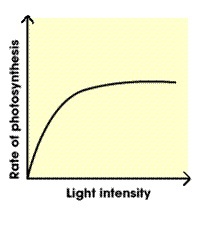 |
| What is the impact of temperature on photosynthesis? |
• the rate of photosynthesis speeds up as temperature rises up to the optimum temperature • the rate of photosynthesis decreases as temperature rises beyond the optimum temperature |
| Why does the rate of photosynthesis fall as the temperature rises beyond the optimum temperature? | the enzymes controlling photosynthesis are denatured slowing down the rate of photosynthesis |
| At what temperature are the enzymes controlling photosynthesis denatured? | between 40 °C to 50 °C |
| Sketch the graph showing the effect of temperature on photosynthesis. | 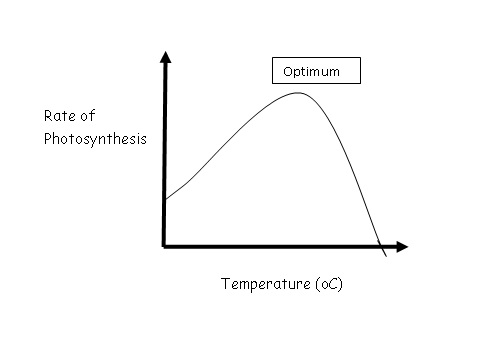 |
| What is the effect of carbon dioxide on the rate of photosynthesis? | the rate of photosynthesis increases as the concentration of carbon dioxide increases |
| Sketch the graph showing the effect of carbon dioxide concentration on photosynthesis. | 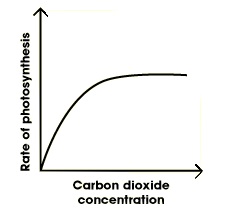 |
| Why do plants need CO2? | to make glucose |
| How much carbon dioxide is in the atmosphere? | the atmosphere is about 0.04% carbon dioxide |
| What is the most common limiting factor for photosynthesis on a sunny day? | carbon dioxide |
| What happens to carbon dioxide around plants at night? | it increases as plants plants respire and do not photosynthesise at night |
| How can the rate of photosynthesis be increased on bright, hot days in a greenhouse? | by increasing the concentration of carbon dioxide in a greenhouse |
| What is the limiting factor in a garden or a woodland? | it can be any or all of light intensity, carbon dioxide concentration, and temperature |
| What chemical in leaves is essential for photosynthesis? | chlorophyll |
| What happens to photosynthesis if the chlorophyll in a leaf is limited? | it will reduce and limit the photosynthesis that happens in the leaf |
| What are variegated leaves? | leaves that are not completely green, sometimes with white patches or even completely white |
| What is the effect on plants of having variegated leaves? | they grow less vigorously than plants with all green leaves |
| State the relationship between distance and light intensity. | the light intensity increases or decreases in inverse proportion to the square of the distance |
| What happens if the distance between a light source and a plant is doubled? | the light intensity is reduced by a quarter |
| Write the equation for the relationship between distance and light intensity. | \( light\; intensity = \frac {1\;}{distance\; squared\;} \) |
| Question | Answer |
|---|---|
| How do plants make food? | by photosynthesis |
| Where do plants make food? | in the leaves and other green parts of the plant |
| Which organisms besides plants photosynthesise? | algae |
| Which organisms of algae and plants produce more oxygen as a result of photosynthesis? | algae |
| When do plant and algal cells respire? | all the time, day and night |
| Where do plant and algal cells get the glucose from used in respiration? | they use part of the glucose that they produce in photosynthesis |
| What is used to break down glucose in respiration? | oxygen |
| Why do cells do respiration? | to obtain energy |
| What are the waste products of respiration? | carbon dioxide and water |
| How are respiration and photosynthesis linked? | chemically, respiration is the reverse of photosynthesis |
| Name a use of the energy from respiration. | it can be used to build larger molecules from smaller molecules |
| Give an example of a large molecule built from smaller molecules. | thousands of glucose molecules are combined into cellulose as (C6H10O5)n |
| What is cellulose used for? | to strengthen cell walls |
| How do plants store glucose? | as starch |
| What is starch? | many thousands of glucose molecules combined together to form a single large molecule |
| Why is glucose not stored as glucose in plants? | as glucose is soluble in water, large quantities of glucose would affect the movement of water in and out of cells by osmosis affecting the balance of water in the plant |
| Why is glucose stored as starch in plants? | starch is insoluble in water so has no affect on the water balance in the plant |
| What is the main energy store in plants? | starch |
| Where is starch found in the plant? | in cells all over the plant |
| Why is starch stored in the leaves of a plant? | to provide energy when it is dark or levels of light are low |
| What is the purpose of a plant tuber? | it is a special storage area for starch in plants |
| Name another special storage area in plants. | bulbs |
| Name an edible tuber. | the potato |
| Name an edible bulb. | the onion |
| State a reason why plants store starch. | to provide energy through winter |
| Name and describe the test for starch. |
• the iodine test • iodine is orange-red and turns blue black in the presence of starch |
| What is evidence that photosynthesis has taken place in a leaf/ | the presence of starch |
| Describe the experiment to show that photosynthesis has taken place in a leaf. |
• take 2 leaves, one that has been in the light for 24 hours and one that has been in the dark for 24 hours • boil the leaves in ethanol until clear • rinse the leaves in hot water • add iodine solution to both leaves • the iodine on the leaf that had been in the light will turn blue-black • the iodine on the leaf that had not been in the sun will remain orange-red |
| Why can iodine solution not be put straight onto leaves picked from a plant? |
• the waxy cuticle of the leaf would prevent the iodine solution reaching the starch in the cells • the green colour of the chlorophyll would mask the colour of the iodine if any managed to reach the starch |
| Why do the leaves need to be boiled before testing for the presence of starch? | to destroy the waxy cuticle and remove the colour from the leaves |
| Why are the leaves boiled in alcohol rinsed in hot water? | to soften the leaves |
| How do plants make amino acids? | they cmobine glucose nitrate ions and other mineral ions from the soil |
| What do the plants do with the amino acids they produce? | they combine them to form proteins |
| Do algae also make proteins? | yes |
| Where do algae get the nitrogen for protein? | they take the nitrates and other ions they need from the water they live in |
| Why do many plants find bogs difficult to live in? | they are wet and the peaty soil contains very few nutrients |
| What types of plants are well adapted to live in nitrate-poor soils? | carnivorous plants |
| Name three examples of carnivorous plants. |
• venus flytraps • sundews • pitcher plants |
| Where do carnivorous plants get their nitrogen? | from the animals like insects that they catch |
| What happens to the insects trapped by carnivorous insects? | they digest them with enzymes they produce then use the nitrates and other minerals from the digested bodies |
| What are lipids? | fats and oils |
| What do plants use to make lipids? | they convert glucose into lipids |
| Why do plants make lipids? |
• as an energy store • to strengthen cell walls |
| Why do plants include lipids in their seeds? | to provide energy for new plant to respire as it germinates and starts to grow |
| Why might some algae be suitable biofuels? | because they are rich in oil |
| What do plants do with the glucose they produce? |
• some is used for respiration • some is converted to starch for storage • some is used to build carbohydrates like cellulose • some is converted to fats and oils • some is converted to amino acids for building proteins |
| Question | Answer |
|---|---|
| Why would farmers want their plants to grow as large and as fast as possible? | larger plants mean more food for them to sell and quicker means receiving their money sooner |
| What does a plant do to add to its biomass? | it performs photosynthesis |
| What would you give to a plant to make it grow as fast as possible? |
• warmth • plenty of light • lots of water • as much carbon dioxide as possible |
| How do gardeners artificially manipulate the environment to maximise plant developmemt? | using a greenhouse |
| How do farmers artificially manipulate the environment to maximise plant developmemt? | using huge plastic polytunnels |
| How do greenhouses and polytunnels traditionally affect the rate of photosynthesis? | raising the temperature of the environment means it is much warmer inside
• encouraging rapid plant growth in plants like tomatoes • making it possible to grow plants that would not grow outdoors in the UK like oranges and peaches |
| How are modern farmers using polytunnels and greenhouses to get more growth? | by controlling light and carbon dioxide instead of just heat |
| How can light be managed in a polytunnel to promote plant growth? | farmers can use artificial lighting to maintain optimum levels of light when light levels are low such as in the early morning or on cloudy days |
| How can soil be replaced to ensure the plants receive a perfect balance of nutrients? | using hydroponics, a system where the plants are grown in water which contains the perfect balance of nutrients |
| What are the advantages to controlling limiting factors in giant greenhouses? | by optimising conditions to maximise photosynthesis, crops will grow quickly producing the best possible yield and highest, quickest profits for farmers |
| How are conditions managed in the giant greenhouses? | by using complex computer software and automation, conditions can be kept at the optimum |
A good tutor can build the confidence of a learner enabling subject success
A private tutor can improve the skills a pupil needs to master a subject
Regular tutoring can drive progress and better results in school subjects
Support can help students and parents make the right academic decisions