KS Learning can provide extra lessons for maths from gcse maths tutors in London and help with gcse maths past papers, gcse maths revision notes, and gcse maths revision worksheets. Maths private tuition at its tuition centre can improve maths knowledge and performance through maths lessons, mathematics tutorials and maths tuition Twickenham.
| Question | Answer | |
|---|---|---|
| Who worked out the first rules of genetic inheritance? | an Austrain monk called Gregor Mendel | |
| When did Gregor Mendel work? | In the mid-19th century - born 1822 and published 1866 | |
| What did did Mendel breed? | pea plants in the gardens of the monastery | |
| What pea qualities interested Mendel? | smooth, wrinkled, green, and yellow peas | |
| What did Menel do with the peas? | he cross bred pea plants and noted pea patterns among the offspring | |
| What did Mendel discover? | that the characteristics were inhereted in clear and predictable patterns | |
| What did Mendel conclude? | there were separate units of inherited material which today are called genes | |
| What did Mendel conclude about the separate units of inherited material? | some characteristics were dominated over others and the characteristics never mixed together | |
| How did scientists respond to Mendel's work? |
• they did not understand Mendel's work • they thus rejected it • Mendel was so upset, that he gave up his work • the work was nearly lost • it was recognised as brilliant 16 years after his death • Mendel never knew that he had made an amazing discovery |
|
| What is the phenotype? | the visible characteristic | |
| What is the genotype? | the pair of genes made up of one inherited from each parent | |
| What is the genotype and phenotype of pea seed Gg? |
• phenotype yellow • genotype Gg |
|
| Explain the terms dominant and recessive? | where an organisms inherits one dominant allele and one recessive allele, the dominant allele will determine the characteristic while the recessive will remain masked | |
| What alleles will a Gg parent produce during reproduction? | Some G alleles and some g alleles which will be inherited separately | |
| Given G stands for yellow dominant peas and g stands for green recessive peas, what will each of the following peas look like • GG • Gg • gg |
With G yellow dominant and g green recessive • GG yellow • Gg yellow • gg green | |
| What tool is used to show monohybrid inheritance? | a punnet square | |
| Draw a punnet square and describe the offspring of parents GG and gg. |
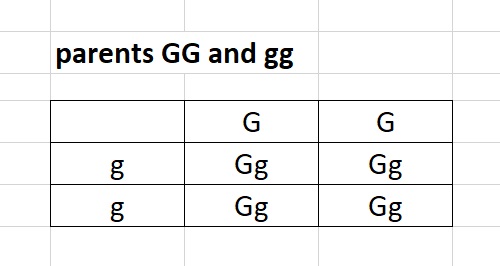 phenotype 100% yelow peas genotype 100% Gg |
|
| Draw a punnet square and describe the offspring of parents Gg and gg. |
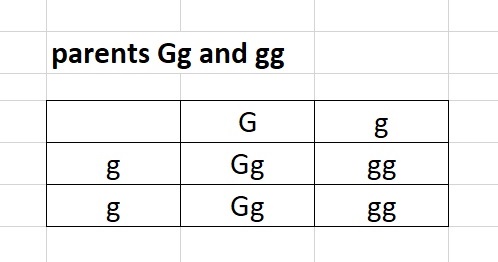 phenotype 50% yelow peas and 50% green peas genotype 50% Gg and 50% gg |
|
| Draw a punnet square and describe the offspring of parents Gg and Gg. |
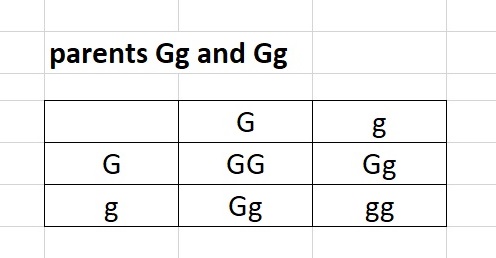 phenotype 75% yelow peas and 25% green peas genotype 25% GG and 50% Gg and 25% gg |
|
| What was the next step in genetics after Mendel's discoveries? | the behaviour of chromosomes during cell division was observed | |
| When did scientists show the DNA is the material of inheritance? | in the 1950s | |
| Name the people in London trying to understand the structure of DNA. |
• Maurice Wilkins • Rosalind Franklin |
|
| Name the people in Cambridge trying to understand the structure of DNA. |
• James Watson • Francis Crick |
|
| What were the London team doing? | looking at the structure of DNA using X-rays | |
| What were the Cambridge team doing? | xtrying to build a 3D model of DNA to understand how it works | |
| How was the DNA structure cracked? |
• Maurice Wilkins and Rosalind Franklin worked at the same university on x-ray crystallography • Rosalind Franklin produced some high quality x-ray patterns for DNA • Maurice Wilkins shared Rosalind Wilkins x-ray results with James Watson and Francis Crick without her permission • James Watson and Francis Crick proposed a structure for DNA • Maurice Wilkins proved the structure to be correct |
|
| Who was credited with the discovery of DNA structure? | Maurice Wilkins, Francis Crick and James Watson received the Nobel prize for the discovery | |
| Why was Rosalind Franklin not credited on the discovery of DNA structure? |
• possibly because she was a woman in a 'man's world' • possibly because she did of breast cancer before the Nobel prize was awarded • possibly because she was considered unpleasant and not liked |
|
| What did the discovery of DNA structure lead to? | gene theory | |
| What does gene theory state? | genes have their effect by coding for proteins |
| Question | Answer |
|---|---|
| Who was Jean-Baptiste Lamark? | a french biologist |
| What was the essence of Lamark's ideas on evolution? | changes that an organism acquires in its lifetime can be inherited by their offspring |
| Describe Lamark's explanation of evolution. |
• every animal evolved from primitive worms • the way an organism behaved affected the features of its body • if the organism repeated the behaviour, the change would grow • if the organism did not use the change, it would shrink and be lost • the change would be inherited by the offspring of the organism • many inherited changes later, the worms would become the organisms known today |
| What is an acquired characteristic? | a feature that an organism develops during its life |
| Describe an example that Lamark would use to illustrate his version of evolution. | the necks of giraffes stretched as they reached for leaves higher up the tree and passed their longer necks on to their offspring |
| Who did the modern understanding of evolution start with? | Charles Darwin |
| When did Darwin set out on his journey voyage? | 1831 |
| How old was Darwin? | 22 years old |
| What was his job? | geologist and companion |
| What was the name of the ship on which Darwin travelled? | HMS Beagle |
| What was Darwin's destination? | South America and South Sea Islands |
| What was Darwin's plan for the jurney? | to study mainly geology particularly rocks and fossils |
| What changed regards his interests? | he became interested in plants and animals |
| What did Darwin notice in South America? | two different types of the same bird (rheas) in different environments |
| Where did Darwin go after South America? | the Galapagos islands |
| What did Darwin notice on the Galapagis Islands? | he found that similar finches on different islands had different adaptations |
| How long was Darwin travelling? | 5 years |
| How long did Darwin spend working on his ideas on his return to England? | 20 years |
| What was the name of the process Darwin discovered? | natural selection |
| What were Darwin's main ideas? |
• the individuals in a species show a wide range of variation for each characteristic • reproduction produces more offspring than the environment can support • the organisms that have the characteristics best suited to survival are the most likely to breed • when they breed, they pass on the characteristics which have enabled them to survive |
| What controls the characteristics that enable survival? | genes |
| Question | Answer |
|---|---|
| What does the theory of evolution by natural selection state? | all species of living organisms have evolved from simple life forms that first developed over 3 billion years ago through natural selection |
| What is a scientific theory? | a scientific theory • is a collection of the scientific knowledge on an aspect of the natural world • includes and explains facts related to an aspect of the natural world • includes laws derived from empiracal data • has been repeatedly tested and verified in accordance with the scientific method • has withstood rigorous scrutiny |
| What is a scientific theory not? |
• it is not just an idea • it is not a guess • it is not unproven • it cannot be dismissed as 'just a theory' |
Distinguish between evolution and natural selection. | Evolution states that all species have developed from simple lfe forms starting more than 3 billion years ago, and natural selection is the process by which evolution comes about |
| What is natural selection? |
• animals and plants are in competition with their own species • those that gain an advantage will survive long enough to breed • they will pass their advantage on to their offspring • those that do not have the advantage will not survive to breed • the characteristic that confers an advantage will become more common, even dominate • nature has "chosen" the individuals that will breed |
| What did Darwin discover? | natural selection and NOT evolution which has been proposed before his time |
| What did Darwin spend years doing before publication of his ideas? | collecting lots of evidence to support natural selection |
| Where did Darwin find his first evidence for natural selection? | the animals and plants he had seen on his journey on HMS Beagle |
| What did Darwin note about the animals of the Galapagos Islands? | organims on different islands had adapted to their environment through natural selection i.e. they had evolved to be different forming new species |
| Name an animal of the Galapagos Islands that illustrates evolution by natural selection. | the finches |
| How do the finches of the Galapagos Islands illustrate evolution by natural selection? | the finches are very similar indicating a common ancestor but have different beaks suited to the available food source of their location from seeds to insects |
| What animals did Darwin focus heavily on in the UK? | he bred and studied pigeons, and he studied different types of barnacles |
| Why did Darwin breed and study pigeons? | he wanted to show how features could be selected |
| What are barnacles? | small invertebrates found on seashore rocks |
| What did Darwin's study of invertebrates reveal? | organisms adapting and forming different species in different environments |
| Why did Darwin publish? | he believed that Alfred Wallace was about to publish the same ideas |
| When did Darwin publish? | 24 November 1859 |
| What was the name of Darwin's book? | 'On the origin of species by natural selection' shortened to 'The Origin of Species' |
| What was the reaction to Darwin's book? |
• it was a sensation • many people were very excited by his ideas • many people rejected the ideas outright • Darwin was not bothered about the fuss |
| What did Darwin do with his original manuscript? | he let his children use it for drawing paper - most of what we have of the manuscript is because Darwin kept it because of his children's drawings |
| What were the objections to Darwin's ideas? |
• it challenged the idea that god created all the animals and plants • many scientists did not feel that there was sufficient evidence to support his ideas • there was no way to explain inheritance and variation - genes and genetics were not discovered until 50 years after Darwin published |
| Where is Darwin buried? | in Westmister Abbey along with other famous scientists like Isaac Newton |
| Question | Answer |
|---|---|
| x | x |
| x | x |
| x | x |
| x | x |
| x | x |
| x | x |
| x | x |
| x | x |
| x | x |
| x | x |
| x | x |
| x | x |
| x |
• x • x • x • x • x |
| x | x |
| x | x |
| x | x |
| x | x |
| x | x |
| x | x |
| x | x |
| x | x |
| x | x |
| x | x |
| x | x |
| x | x |
| x |
• x • x • x • x • x |
| Question | Answer |
|---|---|
| x | x |
| x | x |
| x | x |
| x | x |
| x | x |
| x | x |
| x | x |
| x | x |
| x | x |
| x | x |
| x | x |
| x | x |
| x |
• x • x • x • x • x |
| x | x |
| x | x |
| x | x |
| x | x |
| x | x |
| x | x |
| x | x |
| x | x |
| x | x |
| x | x |
| x | x |
| x | x |
| x |
• x • x • x • x • x |
| Question | Answer |
|---|---|
| x | x |
| x | x |
| x | x |
| x | x |
| x | x |
| x | x |
| x | x |
| x | x |
| x | x |
| x | x |
| x | x |
| x | x |
| x |
• x • x • x • x • x |
| x | x |
| x | x |
| x | x |
| x | x |
| x | x |
| x | x |
| x | x |
| x | x |
| x | x |
| x | x |
| x | x |
| x | x |
| x |
• x • x • x • x • x |
| Question | Answer |
|---|---|
| x | x |
| x | x |
| x | x |
| x | x |
| x | x |
| x | x |
| x | x |
| x | x |
| x | x |
| x | x |
| x | x |
| x | x |
| x |
• x • x • x • x • x |
| x | x |
| x | x |
| x | x |
| x | x |
| x | x |
| x | x |
| x | x |
| x | x |
| x | x |
| x | x |
| x | x |
| x | x |
| x |
• x • x • x • x • x |
| Question | Answer |
|---|---|
| x | x |
| x | x |
| x | x |
| x | x |
| x | x |
| x | x |
| x | x |
| x | x |
| x | x |
| x | x |
| x | x |
| x | x |
| x |
• x • x • x • x • x |
| x | x |
| x | x |
| x | x |
| x | x |
| x | x |
| x | x |
| x | x |
| x | x |
| x | x |
| x | x |
| x | x |
| x | x |
| x |
• x • x • x • x • x |
| Question | Answer |
|---|---|
| x | x |
| x | x |
| x | x |
| x | x |
| x | x |
| x | x |
| x | x |
| x | x |
| x | x |
| x | x |
| x | x |
| x | x |
| x |
• x • x • x • x • x |
| x | x |
| x | x |
| x | x |
| x | x |
| x | x |
| x | x |
| x | x |
| x | x |
| x | x |
| x | x |
| x | x |
| x | x |
| x |
• x • x • x • x • x |
| Question | Answer |
|---|---|
| x | x |
| x | x |
| x | x |
| x | x |
| x | x |
| x | x |
| x | x |
| x | x |
| x | x |
| x | x |
| x | x |
| x | x |
| x |
• x • x • x • x • x |
| x | x |
| x | x |
| x | x |
| x | x |
| x | x |
| x | x |
| x | x |
| x | x |
| x | x |
| x | x |
| x | x |
| x | x |
| x |
• x • x • x • x • x |
A good tutor can build the confidence of a learner enabling subject success
A private tutor can improve the skills a pupil needs to master a subject
Regular tutoring can drive progress and better results in school subjects
Support can help students and parents make the right academic decisions