KS Learning can provide extra lessons for maths from gcse maths tutors in London and help with gcse maths past papers, gcse maths revision notes, and gcse maths revision worksheets. Maths private tuition at its tuition centre can improve maths knowledge and performance through maths lessons, mathematics tutorials and maths tuition Twickenham.
| Question | Answer |
|---|---|
| List 5 energy stores. |
• chemical energy store • kinetic energy store • gravitational potential energy store • elastic potential energy store • thermal energy store |
| Describe a chemical energy store. | the energy in the chemical bonds of substances like fuels, food, or battery acid, that is transferred during chemical reactions |
| Describe a kinetic energy store. | the energy an object has because of movement |
| Describe a gravitational potential energy store. | the energy stored in an object because of its position |
| Describe an elastic potential energy store. | the energy stored in a stretched or squashed object |
| Describe a thermal energy store. | the energy stored in a substance because of its temperature |
| Describe the changes to energy stores when a torch is switched on |
• the chemical energy of the battery is converted to electric energy as the current leaves it to travel around the circuit • the electrical energy is converted to light energy as the current passes through the light bulb • some of the electrical energy is transferred to heat as it passes through the light bulb |
| Describe the energy changes when an electrical kettle boils water |
• electrical energy from the current is transferred to heat energy by the element of the kettle • heat energy of the element is transferred to the water and the kettle • some of the energy from the element is transferred to sound energy |
| Describe the changes to energy stores when a ball is thrown into the air and allowed to fall to the ground. |
• the muscles of the arm contain chemical energy from the food we eat • the muscles of the arm transform chemical energy to kinetic energy in the ball • the ball leaves the hand at a velocity determined by how hard it is thrown • the kinetic energy store of the ball is transferred to its potential energy store as it travels upwards • the ball slows down as it travels upwards until it comes to a stop • the kinetic energy store is zero and the potential energy store is at its maximum when the ball reaches its maximum height and comes to zero • the ball then starts to fall back to the ground gathering speed as it falls • the potential energy store is transferred to the ball's kinetic energy store • the ball hits the ground coming to a stop and making a noise • the kinetic energy store of the ball is transferred to sound and heat energy |
| Question | Answer |
|---|---|
| What is happening to a roller coaster as it climbs an incline? | its gravitational potential energy store is increasing as kinetic energy is converted |
| What is happening to a roller coaster as it races downwards? | its gravitational potential energy store is converted mainly to its kinetic energy store and some into sound and heat energy stores |
| Describe the changes to energy stores in the bob of a pendulum. |
• as the pendulum swings down and towards the centre, its gravitational potential energy store decreases and its kinetic energy store increases • as the pendulum moves upwards and away from the centre, its gravitational potential energy store increases and its kinetic energy store decreases |
| Sketch a graph of the pendulum showing its energy stores. | 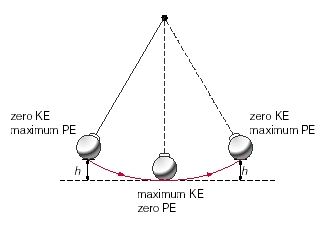 |
| What might prevent the bob of the pendulum reaching the same height on each swing? | air resistance and friction |
| If there were no air resistance or friction, how long would the pendulum swing? | forever because no energy is lost to the potential and kinetic energy stores |
| What is a closed system? | a collection of objects from which energy is not lost to any outside objects and stores |
| State the conservation of energy. | energy cannot be created or destroyed, only transformed |
| What happens to the energy in an elastic band when it is stretched? | its elastic potential energy store increases |
| What happens to the energy in an object as it is lifted? | its gravitational potential energy store is increased |
| What energy transfers happen to a bungee jumper after jumping off the platform? |
• as the jumper hurtles towards the ground, her gravitational potential energy store is converted to her kinetic energy store • when the rope tightens and the elastic stretches, her kinetic energy store is converted to her elastic potential energy store • when the elastic has reached its maximum, it contracts transferring the elastic potential energy store to her kinetic energy store • as she rises towards the platform, the kinetic energy store is transferred to her gravitational potential energy • the process is repeated |
| Why does the bungee jumper not return to the same height? | some energy is transferred to the thermal energy store due to air resistance and the sound energy store of the rope and the surroundings |
| Question | Answer |
|---|---|
| When is work done on an object? | work is done when a force causes an object to move |
| What does the force do to the object in terms of energy? | the force transfers energy to the object |
| State the relationship between work done and energy transferred. | energy transferred is equal to work done |
| Define one joule of work. | one joule of work is done when a force of one newton causes an object to move one metre in the direction of the force |
| State the word equation for work. | work done = force applied x distance moved along the line of action of the force |
| State the symbol equation for work. | W = F x s |
| State the units for work, force, and distance |
• work joules (J) • force newtons (N) • distance metres (m) |
| What happens to work done to overcome friction? | most of it is converted to the thermal energy stores of the objects involved |
| What happens when you rub your hands together and why? | the muscles work to overcome the friction between the hands and the work is transferred to the heat energy stores of the hands |
| Why do the brakes of a car get hot? | friction between the brake pads and the wheel discs opposes the motion of the vehicle and in so doing does work on both transferring energy to their heat stores |
| Describe what happens to meteorites as they enter the atmosphere. |
• as the meteorite pass through the atmosphere, friction caused by the air acts upon it • energy from the gravitational potential energy and kinetic energy store of the meteorite is transformed to thermal energy • the thermal energy store of the meteorite increases, causing the meteorite to heat up • if the meteorite gets hot enough, it will glow and becomes a 'shooting star' • most meteorites heat up so much that they burn up in the atmosphere |
| Question | Answer |
|---|---|
| What happens in terms of energy stores when lifting an object? | muscles transfer energy from chemical energy stores to the gravitational potential energy store in the object |
| What happens to its gravitational potential energy store when an object is lifted? | the energy in the gravitational potential energy store increases |
| Why does the gravitational potential energy increase when an object is lifted | because work is done on the object to overcome the gravitational force |
| What is the increase in the gravitional potential energy equal to when an object is lifted? | it is equal to the work done on the object by the lifting force to overcome the gravitational force on the object |
| What happens to its gravitational potential energy store when an object is moved down? | the energy in the gravitational potential energy store decreases |
| What is the decrease in the gravitational potential energy equal to when an object is moved down? | it is equal to the work done on the object by the lifting force to overcome the gravitational force on the object |
| What does work done depend on when an object moves up or down? |
• how far it is moved vertically • its weight |
| Write the word equation for the change in an object's gravitational potential energy store? | change in object's gravitational potential energy store = weight x change of height |
| Write the symbol equation for the change in an object's gravitational potential energy store? | ΔEp = w x Δh = m g Δh |
| State the units for mass, gravity, and height. |
• mass kilograms (kg) • gravity metres per second squared (m/s2) • height metres (m) |
| Why can astronauts on the moon lift objects much easier than on the earth? | the gravitational field strength on the moon is about a sixth of the gravitational field strength on the earth |
| Question | Answer |
|---|---|
| What does the kinetic energy of an object in motion depend on? | the mass and the speed of the object |
| What happens to the kinetic energy store of an object as its speed increases? | the kinetic energy store of the object increases |
| State the word equation for kinetic energy. | kinetic energy = ½ x mass x speed squared |
| State the symbol equation for kinetic energy. | Ek = ½ x m x v2 |
| State the units for mass and speed. |
• mass kilograms (kg) • speed metres per second (m/s) |
| Where is the work done stored when stretching a rubber band? | in the elastic potential energy store of the rubber band |
| What is the relationship between force and extension in a rubber band or a spring? | force is directly proportional to extension |
| What are the units of extension? | metres (m) |
| What is the relationship between force and extension called? | Hooke's Law |
| Write the word equation for Hooke's Law. | force = spring constant x extension |
| State the symbol equation for Hooke's Law. | F = k x e |
| Draw a graph of of Hooke's Law. | 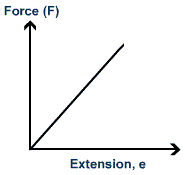 |
| State the word equation for the energy in the elastic potential energy store? | elastic potential energy = ½ x spring constant x extension squared |
| Write the symbol equation for the energy in the elastic potential energy store? | Ee = ½ x k x e2 |
| What does each symbol in Ee = ½ x k x e2 stand for? |
• Elastic potential energy (Ee) in Joules (J) • spring constant (k) in newtons per metre (N/m) • extension (e) in metres squared (m2) |
| Question | Answer |
|---|---|
| What does a machine do in physics? | a machine transfers energy for a purpose |
| What makes the parts of a machine warm up? | friction causes the parts of a machine to warm up |
| Define useful energy. | energy transferred to where it is wanted in the form that it is wanted |
| Define wasted energy. | energy that is not usefully transferred |
| What happens to energy that is not usefully transferred? | it is dissipated and may be stored in less useful ways |
| When a jet plane takes off, the chemical energy of the fuel is transferred by the engines. How is the energy used? | some of the energy is transferred to the kinetic and potential energy stores of the plane (useful energy) and some is transferred to the heat and noise energy stores of the surroundings (wasted energy) |
| What is the impact of friction on machines in terms of useful and wasted energy? | friction always causes energy to be wasted in machines |
| What happens to the energy due to friction when a cyclist brakes? | energy is transferred from the kinetic energy stores of the bicycle and the cyclist to the thermal energy stores of the brakes and the wheels - it is wasted energy |
| What happens to the energy transferred by your muscles on a running machine? | energy is transferred to the thermal energy stores of the muscles making you hot and the thermal energy store of the running machine by the force exerted to overcome the friction of the machine |
| Why do the gears of a car get hot? | energy is transferred from the kinetic energy store of the gear box to the thermal energy store of the surroundings and the gear box |
| What happens to the thermal energy distributed by the radiator of a central heating system? |
• the thermal energy store of the water in the radiator reduces as it transfers it to the thermal energy stores of the radiator • the thermal energy store of the radiator is transferred to the thermal energy store of the air in a room • the thermal energy store of the air of the room is transferred to the thermal energy store of the building • the thermal energy store of the building is transferred to the outside air • energy becomes less useful the more it spreads out |
| What happens to wasted energy? | it is eventually transferred to surroundings which becomes warmer |
| Question | Answer |
|---|---|
| What happens to the energy stored in the arm muscles when an object is lifted vertically? | energy stored in the muscles is transferred to the gravitational potential energy store of the object |
| What does the amount of energy transferred depend on? | the weight of the object and how high it is lifted |
| What are the units of weight? | Netwons (N) as weight is a type of force |
| What is the word equation for weight? | weight = mass x gravity |
| What is the symbol equation for weight? | w = m x g |
| What are the units for gravity? | metres per second squared (m/s2) |
| What is input energy of a device? | the energy supplied to the device |
| What is the useful output energy of a device? | the energy transferred by the device to the place and in the way wanted |
| State the relationship between input energy, useful output energy, and wasted energy. | input energy = useful output energy + wasted energy |
| Why is input energy equal to the sum of useful output energy and wasted energy? | because of the conservation of energy which says that energy cannot be created or destroyed only transformed |
| State the word equation for efficiency. | \( efficiency = \frac {useful\; output\; energy\; transferred\; by\; the\; device}{total\; input\; energy\; supplied\; to\; the\; device} \) |
| What are the units of efficiency? | efficiency is a number expressed as a decimal or a percentage so has no units |
| What is the maximum efficiency? | 100% of 1 |
| How is energy wasted between the moving parts of a machine and how is this reduced? | friction between the moving parts causes heating and lubrication reduces friction |
| How is energy wasted when a current moves through a wire and how is this reduced? | the resistance of the wire transfers some of the electrical energy to heat and using metals like gold for wires reduces the energy transferred to heat because gold has a very low resistance |
| How is energy wasted by a car when it encounters the air in front of it and how is this reduced? | air resistance causes a force that opposes the movement of the car and the shape of the car is streamlined to reduce air resistance |
| How is energy wasted in a white van when it rattles? | the kinetic energy of the white van is transferred to sound energy which can be reduced by damping the parts of the vehicle as is done in more expensive vehicles |
| Question | Answer |
|---|---|
| Name the main sources of energy in the home? | electricity, gas, and oil |
| How is energy transferred to electrical appliances? | the charge that is supplied by the electrical supply transfers energy to the appliance |
| Describe the useful and wasted energy of a light bulb. | the light emmitted by the light bulb is useful energy and the heat generated by the light bulb is wasted energy |
| Describe the useful and wasted energy of an electric heater. | the heat that warms the surroundings is useful energy and the light from the glow is wasted energy |
| Describe the useful and wasted energy of an electric toaster. | the heat that warms and toasts the bread is useful energy and the heat the warms the toaster and the surroundings is wasted energy |
| Describe the useful and wasted energy of an electric kettle. | the heat that warms the water is useful and the heat that heats the kettle and the surroundings is wasted energy |
| Describe the useful and wasted energy of a hairdryer. | the kinetic energy and thermal energy of the air is useful energy and sound and heat that heats the hairdryer is wasted energy |
| Describe the useful and wasted energy of an electric motor. | the kinetic energy of items driven by the motor and the potential energy of items lifted by the motor are useful energy and the sound energy generated by the motor and the heat energy of the motor are wasted energy |
| How does the clockwork radio work? |
• the elastic potential energy store of the clockwork spring in the radio is increased by winding • when the spring unwinds, it transfers energy from its potential energy store to its kinetic energy store • the kinetic energy store of the spring turns a small electric generator • the small electric generator produces a current which powers the radio |
| Question | Answer |
|---|---|
| Describe the energy transfers when a lift ascends powered by an electric motor. | the electric current transfers energy to the gravitational potential energy store of the lift, the thermal energy store of the motor, and the thermal energy store of the surroundings |
| What is power? | the rate of transfer of energy i.e. the energy supplied per second |
| How does the power of an appliance affect the rate of transfer of energy? | the more powerful an appliance is, the faster the rate at which it transfers energy |
| What are the units of power? | watts (W) |
| Define 1 watt. | 1 watt is equal to the rate of transferring 1 joule of energy in 1 second |
| How many watts in a kilowatt? | 1 kilowatt (kW) = 1000 watts |
| How many watts in a megawatt? | 1 megawatt (MW) = 1000000 watts |
| State the word equation for power. | \( power = \frac {energy\; transferred\; to\; appliance}{time\; taken\; for\; energy\; to\; be\; transferred} \) |
| Write the symbol equation for power. | \( P = \frac {E}{t} \) |
| Calculate the power output when a weightlifter lifts a 30kg dumbbell a height of 1m in 0.5s. |
Force = m x g = 30 x 10 = 300 N Work = F x s = 300 x 1 = 300 J Power = E / t = 300 / 0.5 = 600 W |
| State the word equation for efficiency for power. | \( efficiency = \frac {useful\; power\; out}{total\; power\; in} \) x 100% |
| State the equation for wasted power. | power wasted = total power in - useful power out |
A good tutor can build the confidence of a learner enabling subject success
A private tutor can improve the skills a pupil needs to master a subject
Regular tutoring can drive progress and better results in school subjects
Support can help students and parents make the right academic decisions