KS Learning can provide extra lessons for maths from gcse maths tutors in London and help with gcse maths past papers, gcse maths revision notes, and gcse maths revision worksheets. Maths private tuition at its tuition centre can improve maths knowledge and performance through maths lessons, mathematics tutorials and maths tuition Twickenham.
| Question | Answer |
|---|---|
| Name the sub-atomic particles in the nucleus. | protons and neutrons |
| Who described the particles in the nucleus? | Ernest Rutherford |
| Describe the structure of the atom. |
• a nucleus in the centre that contains protons and neutrons • electrons travelling around the nucleus in shells |
| Where does radioactivity come from in the atom? | from the nucleus |
| What causes radioactivity? | an unstable nucleus |
| Why does a nucleus emit radiation? | to become stable |
| Are all nuclei radioactive? | no, in fact most nuclei are NOT radioactive |
| Name the equipment used to measure radioactivity? | a geiger counter |
| Name the three types of natural radiation. |
• alpha radiation α • beta radiation β • gamma radiation γ |
| Name the charge of each type of natural radiation from radioactive substances. |
• alpha radiation is positive • beta radiation negative • gamma radiation is neutral |
| Name two radioactive substances. | uranium 238 and plutonium 239 |
| How is a nucleus described when it emits radiation? | it is described as decaying when it emits radiation |
| How can one tell when a radioactive nucleus will decay? | it is not possible to tell when a particular radioactive nucleus will decay as radioactive decay is totally random |
| Question | Answer |
|---|---|
| What did Rutherford realise could be used to probe the atom? | alpha (α) particles |
| Who did Rutherford ask to investigate the atom? | two students, Hans Geiger and Ernest Marsden |
| What experiment were Hans Geiger and Ernest Marsden asked to do? | to investigate how a thin metal (gold) foil scatters a beam of alpha particles |
| Describe the equipment used |
• the apparatus was placed in a vacuum to prevent air molecules absorbing the alpha (α) particles • the alpha source was placed in a lead box with a single narrow hole to create a thin beam of alpha particles • a fixed thin metal foil was placed in front of the alpha beam • a detector is placed at different points around the equipment |
| How were the alpha (α) particles detected? |
• a microscope was focused on a small glass plate • particles hitting the glass plate emitted a flash of light • the detector was moved to different positions • the number of light flashes was observed in each position |
| What were the results of the alpha (α) particle experiment? |
• most of the alpha particles passed straight through the foil without any change of direction • some passed through the foil with a change of direction - the alpha particles were deflected • a very small number, about 1 in 10000, did not pass through the foil but returned back towards the source |
| Describe an alpha particle. |
• two protons and two neutrons • positively charged |
| What is the radius of an atom? | 10-10 m |
| What did Rutherford deduce? |
• the nucleus is positively charged • the nucleus is very dense • most of the atom is empty space, with the nucleus being very, very small |
| Why was Rutherford's nuclear model accepted? |
• it explained the measurements of Geiger and Marsden • it explained radioactivity in terms of changes that happen to an unstable nucleus • it predicted the existence of the neutron |
| Describe the plum pudding model. | the atom is positively charged matter with negatively charged particles embedded in it like the raisins in a currant bun |
| Why was the plum pudding model rejected? | alpha particles would not be able to pass through foil made of solid particles packed tightly together |
| What did Neils Bohr propose? |
• electrons orbit the nucleus at specific distances • the distance from the nucleus repesents a specific energy level • electrons can move from one energy level to another • electrons move away from the nucleus by absorbing electromagnetic radiation • electrons move closer to the nucleus by emitting electromagnetic radiation |
| What evidence supported Bohr's model? | the light emitted by atoms called spectra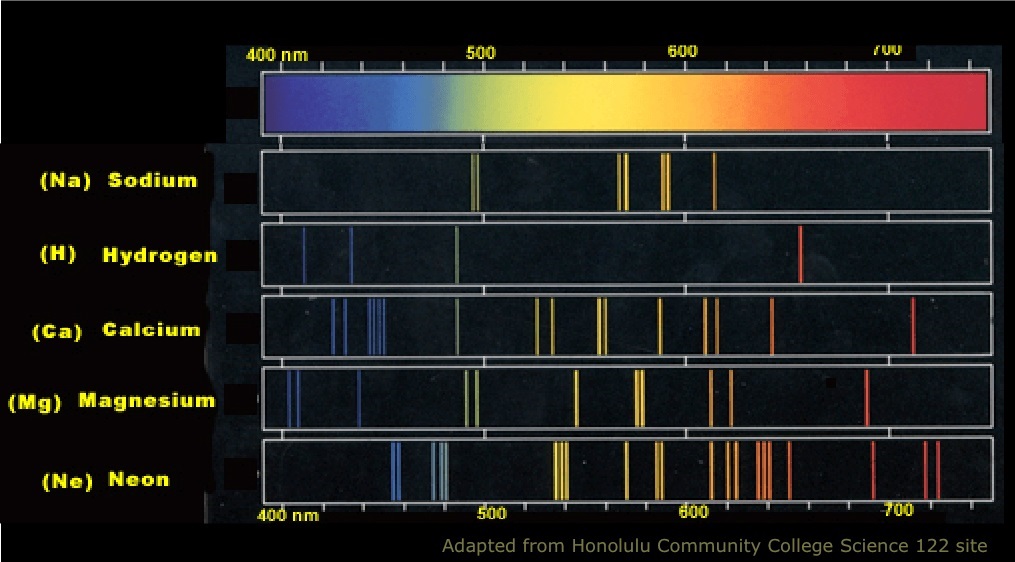
|
| What did later alpha (α) particle experiments show? |
• the hydrogen nucleus contained the least amount of charge • the charge of the nucleus is shared between a whole number of smaller particles • the smaller particles making in the nucleus each have the same amount of positive charged |
| What name was given to the Hydrogen nucleus? | the proton |
| What evidence was there for an uncharged particle in the nucleus? | the mass of every nucleus except for Hydrogen, is larger than the total mass of its protons |
| What was the uncharged particle called? | the neutron |
| Why was the proton-neutron model accepted? | it explains all the mass and charge values of every nucleus |
| When was the existence of the neutron accepted? | James Chadwick, a physist, obtained direct experimental evidence 20 years after Rutherford's discovery of the nucleus |
| Question | Answer |
|---|---|
| What is an alpha particle? | it contains two protons and two neutrons, the same as the nucleus of a Helium atom |
| What is a beta particle? | a single electron |
| Where do beta particles come from? | the nucleus and not the shells |
| Where do alpha particles come from? | the nucleus |
| What happens to the nucleus with alpha decay? | the number of protons and neutrons decreases by two of each for every alpha particle released |
| What happens to the nucleus with beta decay? | the number of protons increases by one and the number of neutrons decreases by one for every beta particle released |
| What are the relative masses of protons, neutrons, and electons? | 1, 1, and 1/2000 respectively |
| What are the relative charges of protons, neutrons, and electrons? | +1, 0, and -1 respectively |
| What is the atomic number of an element? | the number of protons in the nucleus with symbol Z |
| What is the mass number of an element? | the number of nucleons (protons plus neutrons) with symbol A |
| What is an isotopes? | All the atoms of an element have the same number of protons but they can have different numbers of neutrons. Each version of an element is known as an isotope. Carbon can have 6, 7, or 8 neutrons referred to as isotpes carbon-12, carbon-13, and carbon-14. |
| Show how to represent an element of an isotope. |  |
| Describe an alpha particle. | it contains two protons and two neutrons, has a relative mass of 4 and a relative charge of +2 |
| What is the symbol for an alpha particle? | 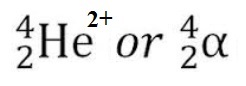 |
| What happens to the atomic and mass numbers when an atom emits an alpha particle? | the atomic number goes down by 2 and the mass number goes down by 4 |
| Write an equation for the decay of Uranium-238 due to α emission. |

|
| Explain what happens in the above equation. |
• the numbers along the top are the number of nucleons • the numbers along the bottom are the number of protons • Uranium-238 has 238 nucleons and 92 protons • Uranium-238 decays by the emission of an alpha particle losing 2 protons and 2 neutrons • Uranium-238 loses two protons becoming Thorium-234 with its atomic number falling from 92 to 90 • Uranium-238 loses four nucleons with its mass number falling from 238 to 234 |
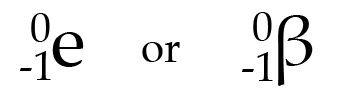
| What is a beta particle (β)? | an electron created in the nucleus and emitted from the nucleus |
| How is the β particle created in β emission? | a neutron changes into a proton and an electron |
| What is the relative mass of a β particle? | negligble so as good as zero in many situations |
| What is the relative charge of a β particle? | -1 |
| What is the symbol for a β particle? |
|
| When can a nucleus decay by the emission of a β particle? | when a nucleus is unstable because it has too many neutrons |
| How is the nucleus changed by β emission? |
• the number of protons increases by 1 • the element changes because of the change in the number of protons • the number of neutrons decreases by 1 • the number of neucleons remains the same • the mass of the nucleus does not change because the number of nucleons remains the same |
| How is the charge of the nucleus changed by β emission? | the positive charge of the nucleus changes by 1 |
| Write an equation for the decay of Potassium-40 by β emission. |
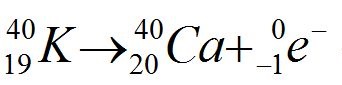
|
| Explain what happens in the above equation. |
• the numbers along the top are the number of nucleons • the numbers along the bottom are the number of protons • Potassium-40 has 40 nucleons and 19 protons • Potassium-40 decays by the emission of a beta particle • the number of protons in the nucleus increases by 1 from 19 to 20 changing Potassium-40 to Calcium-40 • the number of protons in the nucleus increases by 1 from 19 to 20 changing the atomic number from 19 to 20 • the number of nucleons does not change so the mass number does not change |
| What is gamma radiation? | electromagnetic radiation from the nucleus |
| What is the charge of a gamma particle (γ)? | it has no charge |
| What is the mass of a gamma particle (γ)? | it has no mass |
| How are the nucleons affected by γ emission? | there is no change to the nucleons so neither charge nor mass is affected by γ emission |
| When are neutrons emitted? | some radioactive substances can emit a neutron when an α particle collides with the nucleus |
| What is the effect of the emission of a neutron on the nucleus? | the unstable nucleus becomes even more unstable |
| Why can neutrons pass through substances more easily than an α particle or a β particle? | because neutrons are not charged |
| Question | Answer |
|---|---|
|
What stops each type of natural radiation? • alpha α • beta β • gamma γ |
In order, natural radiation is stopped by - • a thin sheet of paper or skin stops α • 5mm thick aluminium sheet or 2mm thick lead stops β • concrete at least 1m thick, or lead sheet which is several cm thick stops γ |
|
How far does each type of natural radiation travel in air? • alpha α • beta β • gamma γ |
In order, natural radiation travels a distance of - • about 5cm with α • about 1m with β • unlimited with γ 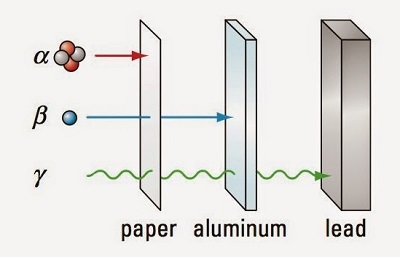
|
| What is background radiation? | radiation from unstable nuclei in materials in the surroundings and the atmosphere |
| Describe the procedure to measure the effectiveness of an absorber material like 5mm aluminium sheet? |
• measure the background radiation using a geiger tube • place the absorber sheet between the source and the geiger tube • subtract the background radiation from the reading with the absorber sheet • the resulting figure is the amount of radiation that passes through the sheet • repeat the procedure with different materials and thickness |
| Describe the procedure to measure the distance that a type of radiation travels in air |
• measure the background radiation using a geiger tube • place a geiger tube in front of a radioactive source • take a reading on the geiger counter • subtract the background radiation from the reading • move the geiger away from the source and repeat the procedure • when the count reading reaches zero, this is the range of the radiation |
| What happens when radiation hits an atom? |
• it can knock an electron off the atom • this gives the atom a charge making it an ion • this is called ionisation |
| What is said to happen when a substance is irradiated? | it is exposed to ionising radiation but does not become radioactive |
| What is radioactive contamination? | radioactive contamination happens when radioactive material is deposited on or in non-radioactive material where it is unwanted |
| Aside from alpha, beta and gamma radiation, what else can cause ionisation? |
• x-rays • fast-moving protons • fast-moving neutrons |
| What effect can ionisation have on a cell? | it can damage or kill a cell |
| What effect can ionisation have on DNA? | it can change genes, changes which can be passed on to offspring with good, bad, or neutral effects |
| How does the ionising power of the different types of radiation compare? |
• all types of natural radiation are highly ionising • alpha particles are the most ionising particles • from most to least ionising, the particles are alpha, beta, and gamma |
| What is peer review? | the work of one or more scientists is checked and tested by other experts and scientists |
| How does a smoke alarm work? |
• smoke alarms contain a radioactive substance that emits alpha particles • the alpha particles into a gap in the circuit • the alpha particles ionise the gap in the air • the ions allows a current to travel across the gap • smoke in the gap absorbs the ions • this stops the current which sets of the alarm |
| Why does a smoke alarm not use beta or gamma radiation? | neither beta nor gamma radiation can ionise sufficient atoms to allow a current to flow across the gap |
| How is radiation used in metal foil production? |
• beta radiation is used to monitor thickness automatically • a radioactive source directs beta radiation at the metal foil • a detector is set up on the other side of the metal foil • the amount of radiation passing through the foil depends on the thickness of the metal foil • if the beta radiation passing through the foil falls, a signal is sent to the rollers to increase the pressure on them and make the foil thinner • if the beta radiation passing through the foil rises, a signal is sent to the rollers to decrease the pressure on them and make the foil thicker |
| Why is gamma radiation not used to monitor the thickness of metal foil in production? | all the gamma radiation will pass through the metal no matter what the thickness of the foil |
| Why is alpha radiation not used to monitor the thickness of metal foil in production? | the metal foil would stop all the alpha particles no matter what the thickness of the foil |
| Question | Answer |
|---|---|
| What is the same in every atom of an element? | the number of protons in the nucleus |
| What can vary between atoms of an element? | the number of neutrons in the nucleus and the number of electrons around the nucleus |
| What is an isotope of an element? | nuclei of an element with different numbers of neutrons are isotopes of an element, for example carbon-12, carbon-13 and carbon-14 are all isotopes of the element carbon |
| Define the activity of a radioactive source. | the number of unstable atoms that decay per second |
| What are the units of activity of a radiactive source? | Becquerel (Bq) where 1 Becquerel is 1 decay per second |
| What happens to the actvity of a radioactive source with time? | as each unstable atom (the parent atom) decays, the number of unstable atoms decreases so the activity decreases |
| What equipment is used to monitor the activity of a radioactive sample? | a Geiger counter |
| What is a Geiger counter used to measure? | the count rate of the sample |
| What is the count rate? | the number of counts per second |
| What is the link between activity and count rate? | the count rate is proportional to the activity of the radioactive source |
| Sketch a graph of the count rate for a sample with time. |
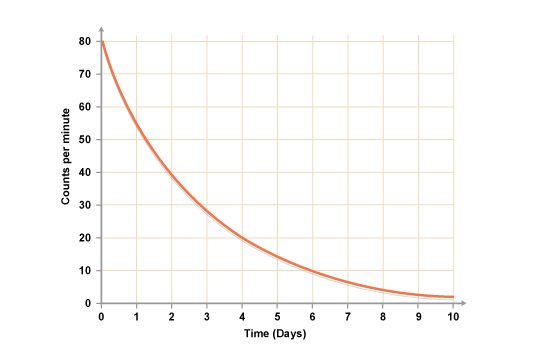
|
| What is half life? | the average time taken for the count rate (and therefore the number of parent atoms) to reduce to half |
| Why is decay described as random? | because it is not possible to predict when a specific atom will decay |
| What can be predicted about the number of atoms decaying? | it is possible to predict the number of atoms that will decay in a given time |
| What is the count rate after n half-lives? | count rate = the intial count rate ÷ 2n |
| Question | Answer |
|---|---|
| What are the two tasks that nuclear radiation is used to achieve in medicine? |
• to diagnose internal disorders • to treat disorders |
| List 4 specific examples of nuclear radiation being used in medicine. |
• radioactive tracers to trace the flow of a substance through an organ • gamma cameras to take images of internal organs • gamma radiation to destroy cancerous tumours • radiactive implants to destroy cancer cells |
| How does a radioactive tracer work? |
• a tracer containing a radioactive isotope is introduced to the body • the tracer emits gamma radiation that can be detected outside the body |
| Describe a specific example of a tracer in medicine. | radioactive iodine is used to detect blockages in the kidneys |
| Describe in full how an iodine tracer is used to detect if there is a block in the kidney |
• the patient drink water containing a small amount of a radioactive isotope of Iodine • a detector is placed against each kidney • each detector is connected to a chart recorder • the radioactive substance flows in and out the kidney emitting gamma rays • in a healthy kidney the chart recorder goes up and down because the radioactive substance enters and leaves the kidney • in a kidney with a block the chart recorder goes up and stays up because the radioactive substance is trapped in the kidney |
| Why is radioactive iodine used? |
• its half-life is eight days, so it last long enough to conduct the test to be completed but short enough to completely decay within a few weeks • its emits gamma radiation, so can be detected outside the body • it decays into a stable product |
| What are gamma cameras used for in medicine? | they are used to take pictures of internal organs |
| How does a gamma camera work? |
• the patient is injected with a solution of gamma-emitting radioactive isotopes • the solution is absorbed by the organs • a nearby gamma camera detects the gamma radiation emitted by the solution • gamma rays pass through the thick lead grid at the front of the detector • the detector only detects gamma rays from nuclei directly in front of the detector • the detector signals are used to build up a picture of the organ |
| What are the required properties of the radioactive isotope used in the gamma camera? |
• it must emit gamma radiation • it must have a half-life long enough to form an image • it must have a half-life short enough for the isotope to decay fully shortly after the picture has been taken |
| How is gamma radiation used to destroy cancerous tumours? |
• a radioactive isotope of Cobalt is used to produce a narrow beam of gamma radiation • the beam of gamma particles is directed at the tumour |
| Why is gamma radiation used to destroy cancerous tumours? | because it can penetrate deeper into the body than beta and alpha radiation |
| What is the half-life of the radioactive Cobalt used to destroy cancerous tumours? | five years |
| What are radioactive implants used for in medicine? | they are used to destroy cancerous cells in tumours |
| What is implanted in radioactive implants? | gamma and beta radioactive isotopes are implanted in the form of small seeds or rods |
| What are the criteria for choosing suitable isotopes for radioactive implants? |
• they must last long enough to kill the cells of the tumour • they must decay fast enough that most of the radioactive nuclei have decayed shortly after implant |
| What is background radiation? | ionising radiation from radioactive substances in the environment |
| Name a source of background radiation? | radon gas |
| Where is backrground radiation found and who does it affect? | it is found everywhere and affects everyone |
| What is the risk due to background radiation? | it is not zero but it is very small |
| Why are people working with ionising made to follow strict rules? | to reduce the risk of being exposed to dangerous levels of radiation |
| How does a person working with ionising radiation know when they are in danger of being exposed to too much radiation? | the personal radiation monitor, such as a film monitor, that the person is wearing will change colour |
| Question | Answer |
|---|---|
| What is the process by which energy is released in a nuclear reactor? | nuclear fission |
| What happens in induced fission? | a neutron is fired at a fissionable element causing the atom to split into smaller elements releasing several neutrons and energy |
| Why is referred to as induced fission and not just fission? | it does not occur naturally and requires humans to initiate it |
| Can fission happen without a neutron being absorbed? | yes, but it is very rare and known as spontaneous fission |
| What happens to the atom in spontaneous fission? | just like in induced fission, it splits and releases several neutrons |
| When a nucleus undergoes fission, what exactly does it release? |
• two or three neutrons at high speed • energy in the form of gamma radiation • energy as kinetic energy stored in the neutrons • energy as kinetic energy stored in the fragment nuclei |
| What happens to the neutrons released by fission in a nuclear fission reactor? |
• they cause other fissionable nuclei to split which each release more neutrons causing other fissionable nuclei to split and so on • a chain reaction is started releasing a steady stream of energy |
| Sketch a chain reaction in a nuclear reactor. |

|
| What must be in the fuel of a nuclear reactor? | fissionable isotopes |
| What fuel is used in most modern nuclear reactors? | enriched Uranium |
| What isotopes of Uranium are found in enriched Uranium and in what quantities? | 2 to 3% Uranium-235, and the rest Uranium-238 |
| How does natural Uranium compare with enriched Uranium? | natural Uranium is more than 99% Uranium-238 |
| What happens to the Uranium-235 nuclei in a nuclear reactor? | Uranium-235 is fissionable so it splits when hit by neutrons and produces more neutrons |
| What happens to the Uranium-238 nuclei in a nuclear reactor? |
• Uranium-238 is not fissionable so does not undergo fission • Uranium-238 is does change into other heavy nuclei |
| What is the main product of Uranium-238 changing? | plutonium-239 |
| Is plutonium-239 usuable in a nuclear reactor? | Pu-239 is fissionable but not in a U-235 reactor - it needs a different type of reactor |
| What is the most common type of reactor? | a uranium-235 reactor |
| Sketch and label a nuclear reactor. |
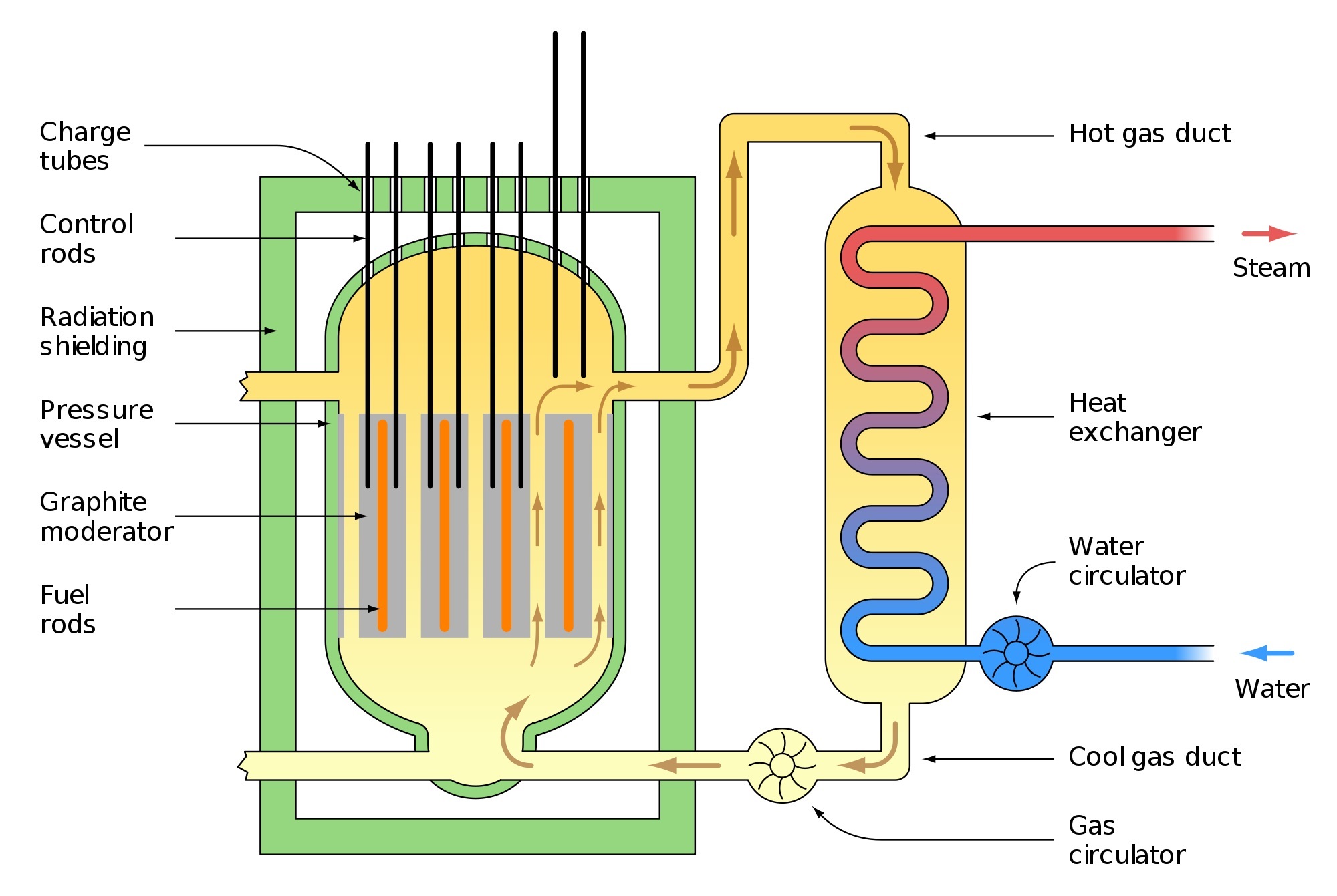
|
| What is in the reactor core? |
• fuel rods • control rods • water at high pressure |
| What is the role of the fuel rods? | the fuel rods contain the fissionable material which will produce energy once neutrons are fired at it and begin the chain reaction |
| What do the control rods do? |
• they are spaced out evenly in the core • they control the chain reaction • they absorb surplus neutrons • when pushed deeper into the reactor, they absorb more neutrons slowing down the reaction • when pulled out of the reactor, they leave more neutrons free to cause fission and speed up the reaction |
| What is the role of the water? |
• the water (referred to as a moderator) slows down neutrons because fast neutrons do not cause fission in U-235 • the fuel rods become very hot and the water cools them down • the water becomes hot so transfers heat from the core to the heat exchanger |
| What happens to the water in the core? |
• it is pumped through the core • it gets hot in the core • it leaves the core through sealed pipes • it reaches a heat exchanger where it cools • it returns to the core |
| Describe the reactor core |
• the vessel is made of thick steel to withstand the high water temperature and pressure • the vessel is enclosed by thick concrete walls to absorb ionising radiation that escapes the steel |
| What does the heat exchanger do? |
• the water from the core heats water in the heat exchanger • the water in the heat exchanger is heated to become steam • the steam is pumped to turbines • the turbines produce electricity • the steam condenses • the water is returned to the heat exchanger |
| Question | Answer |
|---|---|
| Where does the energy come from in stars? | energy is released by fusing together small nuclei like Hydrogen to form larger nuclei |
| Could water be used to generate energy? | yes, fusing together the hydrogen atoms in a glass of water would release as much energy as is contained in a tanker of petrol |
| What is nuclear fusion? | two small nuclei being fused together to form a single large nucleus |
| Where does the energy come from in nuclear fusion? | some of the mass of the small nuclei is converted to energy |
| Can any size nuclei be fused? | nuclear fusion happens only if the relative mass of the nucleus formed is no more than around 55 (the approximate mass of iron) |
| Can nuclei greater than Iron be formed? | at exceptional temperatures and pressures such as those in a super nova |
| What is the approximate composition of the sun? |
• 75% hydrogen • 25% helium |
| Describe fusion in the sun? |
• the core of the sun is so hot that it is made up of a plasma of bare nuclei without electorns • the bare nuclei move around and collide • when they collide, they can fuse together to form larger nuclei • hydrogen nuclei (protons) fuse together to form helium nuclei • at each stage of the fusing, energy is released |
| Describe the steps by which hydrogen fuses to form helium. |
• two protons (hydrogen nuclei) fuse to form heavy hydrogen 21H • more protons fuse forming more heavy hydrogen nuclei • two heavy hydrogen nuclei fuse to form a helium nucleus 42He • energy is released at each stage and carried away as kinetic energy of the products of the fusion |
| Can fusion be used as a useful source of energy? | it may one day be possible but currently there are enormous technical difficulties in producing a fusion reactor that provides energy |
| What are the difficulties with producing a nuclear fusion reactor? | the plasma of light nuclei must be at very high temperatures and pressure for fusion to occur |
| Why are high temperatures and pressures required for hydrogen nuclei (protons) to fuse? | because both are positive, they repel naturally unless moving fast enough to overcome the repulsion between the nuclei |
| What happens in a fusion reactor? |
• the plasma is heated by passing an extremely large current through it • the plasma is prevented from touching the walls of the container by a magnetic field • if the plasma touched the container walls, it would cool and fusion would stop |
| What is necessary for a fusion reactor to be useful? | the energy released by fusion must be greater than the energy required to heat the plasma |
| Has a successful fusion reactor been built? | yes, but it is only successful for a few minutes |
| What are the benefits of fusion? |
• the fuel for fusion, heavy hydrogen, is readily available in sea water • the reaction product, helium, is a non-radioactive gas, so harmless • the energy released can be used to produce electricity |
| What are the disadvantages of fission reactors by comparison to fusion reactors? |
• most fusion reactors use uranium which is only found in some parts of the world • fission reactors produce radioactive waste that has to be stored for many years |
| What is the advantage of fission reactors by comparison to fusion reactors? | fission reactors have been successful built and operated for over 50 years while fusion reactors are still being developed |
| Question | Answer |
|---|---|
| Why does a Geiger counter click when there is no radioactive source near it? | because of background radiation |
| Where can radioactive substances be found? | radioactive substances occur naturally all around one including in people |
| What makes radiation dangerous? | it ionises substances |
| Name the sources of background radiation. |
• cosmic rays • ground and buildings • food and drink • air • medical applications • nuclear weapons test • air travel • nuclear power |
Name the medical sources of radiation? |
• X-rays • radioactive substances such as those used to treat cancer |
| What is the main cause of background radiation in the air? | Radon gas |
| Where does Radon gas come from? | it comes from rocks deep underground |
| When does Radon gas become dagerous? | when it is breathed in |
| Why is Radon gas hazardous? | Radon gas emits alpha particles |
| How does Radon gas enter people's homes? | it seeps up through the ground through cracks, holes, and gaps in houses |
| What can be done to homes where Radon gas is a problem? | pipes can be fitted under the home and fitted to a suction pump to draw the Radon gas away from the infected home |
| What is the state of fuel rods when spent? | they are radioactive and extremely hot |
| What is done with used fuel rods when they are moved from the reactor? | they are stored in big tanks of water for up to a year to cool down |
| What is done with the fuel rods after cooling for a year? |
• remote-controlled equipment is used to open the fuel rods • the unused uranium and plutonium is removed chemically from the used fuel • the unused fuel is stored in sealed containers for reuse • the used fuel is stored securely for many years |
| Why is the used fuel from a nuclear reactor stored securely? | because it contains many radioactive isotopes with long half live so while it is not useful for nuclear reactor, it is still very dangerous |
| What could happen if the used fuel from a nuclear reactor were not stored securely? | it could contaminate the environment with dangerous radioactive isotopes |
| Describe the Chernobyl disaster |
• in 1986, a nuclear reactor in Ukraine exploded • a cloud of radioactive material drifted over Europe inluding the UK • over 100 000 people had to be evacuated • over 30 people died in the accident • many people have developed cancers like leukaemia, as a result |
| What went wrong at Chernobyl? |
• the reactor did not have a high speed shutdown system • the operators ignored safety instructions |
| What happened at Fukushima in Japan? | in March 2011, three nuclear reactors were crippled by an earthquake and a tsunami |
| What precautionary action was taken after the Fukushima disaster? | the population in a 20km radius was evacuated |
| What will need to be monitored for many years after the Fukushima disaster? |
• radiation levels • food and milk production • health effects |
| When will most of the world's nuclear reactors need replacing? | over the next 20 years |
| What features might new nuclear reactors have? |
• a standard design to keep design and maintenance costs down • a longer operating life, possibly 60 years • more safety features • less effect on the environment |
| What is the link between half life and nuclear instability? | isotopes with the shortest half-lives have the most unstable nuclei so emit the most radiation in a short period of time |
| What does the half-life of an isotope say about the isotope? | it is a measure of how quickly the activity of an isotope decreases |
| What happens to a radioactive source over time? |
• the activity of the source decreases with time • the rate at which it gives out radiation decreases • the ionising effect and hence danger, decrease with time |
| What factors determine the effect of radiation on cells? |
• the type of radiation • the amount of the radiation received • whether the radiation is internal or external to the body • the length of time cells are exposed to radiation |
| What is the risk of cancer due to radiation? |
• radiation kills or damages cells • the higher the dose (type and amount) of radiation, the greater the risk of cancer • the risk is never zero no matter how small the dose of radiation • the risk of cancer due to background radiation is very low, but not zero |
A good tutor can build the confidence of a learner enabling subject success
A private tutor can improve the skills a pupil needs to master a subject
Regular tutoring can drive progress and better results in school subjects
Support can help students and parents make the right academic decisions