KS Learning can provide extra lessons for maths from gcse maths tutors in London and help with gcse maths past papers, gcse maths revision notes, and gcse maths revision worksheets. Maths private tuition at its tuition centre can improve maths knowledge and performance through maths lessons, mathematics tutorials and maths tuition Twickenham.
| Question | Answer |
|---|---|
| What is a plane mirror? | a perfectly flat mirror |
| What is the normal on a mirror? | a line drawn perpendicular to the mirror at a point on the mirror |
| What is reflection? | when light strikes a surface and then travels away from the barrier, it is said to have been reflected |
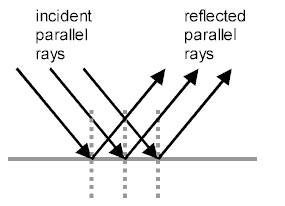
| What is the incident ray in reflection? | the ray that travels towards and strikes the surface
|
| What is the reflected ray in reflection? | the ray that travels away from the surface after striking it
|
| Compare the frequency of the incident and reflected rays. | the incident and reflected rays have the same frequency |
| Compare the speed of the incident and reflected rays. | the incident and reflected rays have the same speed |
| What is the angle of incidence? | the angle between the incident ray and the normal |
| What is the angle of reflection? | the angle between the reflected ray and the normal |
| State the law of reflection. | the angle of incidence = the angle of reflection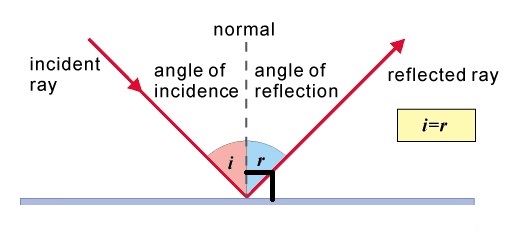
|
| How is a point image formed in a mirror? |
• the light strikes the mirror • the light is reflected off the mirror obeying the law of reflection • the light reaches the eye and the signal sent to the brain • the brain assumes that the light travelled in a straight line from object to eye • the brain extends the rays of light to behind the mirror until they intersect 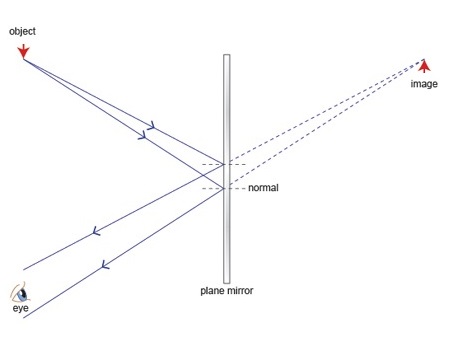
|
| Compare the properties of the object and the image formed in a plane mirror. |
• the image and object are the same size • the image and object are the same distance from the mirror. • the image and object are the same way up • the object is back-to-front compare the image (lateral inversion) • the image is virtual 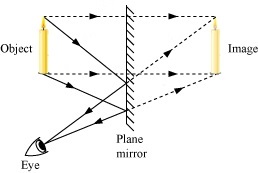
|
| What is a virtual image? | a virtual image is formed at a place where light rays appear to come from after they have been reflected or refracted |
| What is a real image? | a real image is formed by focusing light rays onto a screen |
| State an example of a virtual image. | the image in a mirror |
| State an example of a real image. | the image on the screen at the cinema |
| Why is it possible to see a clear image in a mirror? | a mirror has a smooth surface that reflects rays without scattering them |
| What is reflection called from a smooth surface? | specular reflection because parallel light rays are reflected in a single direction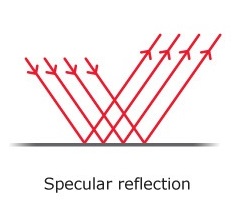
|
| What is reflection called from a rough surface? | diffuse reflection because the light is scattered in different directions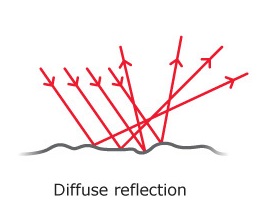
|
| Question | Answer |
|---|---|
| What is refraction? | the bending of light when it passes from one medium to another |
| Name two types of waves that are refracted. | light and sound |
| When does refraction happen with water waves? | when water waves move from deep to shallow water at a non-zero angle |
| What happens to a wave when it is refracted? | the wave changes speed and therefore direction |
| Why is light refracted between air and glass? | light travels more slowly in glass than air |
| Considering light moving from air into glass and out again, how is light refracted? |
• from air into glass, light bends towards the normal • from glass into air, light bends away from the normal 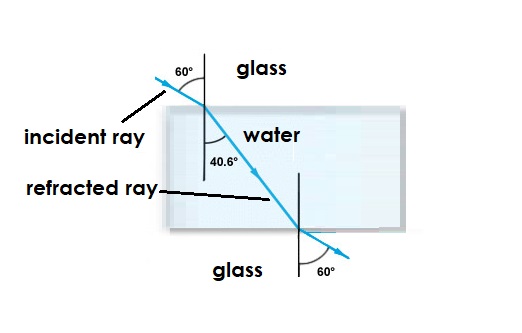
|
| Which is more optically dense, glass or air? | light moves more slowly in glass than air, so glass is more optically dense |
| State the general rule for refraction for light. |
• light bends towards the normal when moving from a less to more dense medium • light bends away from the normal when moving from a more to a less dense medium |
| Why do you see a faint reflection of yourself when looking through a mirror? | because part of the light is reflected and part diffracted |
| Is the refracted ray as strong as the incident ray? | when waves cross a boundary between two materials, partial reflection can happen as well as refraction in which the refracted ray will be weaker than the incident ray |
| What is partial refraction? | when the incident ray light is not fully refracted but some is reflected |
| Why do refracted rays have a smaller amplitude than the incident ray? | the refracted rays lose energy at the boundary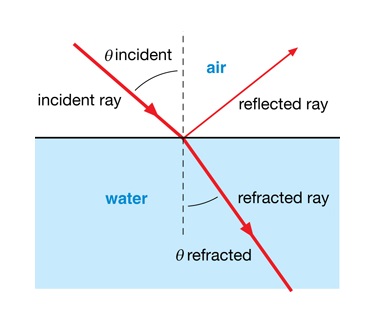
|
| State the refraction rules for angles. |
• when light passes from a less to a more dense medium, the incident angle is greater than the refracted angle • when light passes from a more to a less dense medium, the incident angle is less than the refracted angle |
| Question | Answer |
|---|---|
| What defines a colour of light? | the frequency (or wavelength) of the light |
| Do all light sources emit the same wavelengths of light? | no, each light source emits its own range of wavelengths |
| Name two light sources that emit a broad spectrum of light. |
• stars like the sun emit light that has a continuous range of wavelengths across the visible spectrum • a filament lamp is also a white light source |
| Name two light sources that emit a narrow range of wavelengths |
• lasers • neon lamps • a sodium light emits a yellow/orange light |
| How does a colour filter work? | it absorbs certain wavelengths and transmits other wavelengths |
| What happens if white light is directed at a red filter? | red light will be transmitted and all other wavelengths of light will be absorbed |
| What are the primary colours of light? | red, blue, and green |
| Why are red, blue and green referred to as the primary colours of light? | because they can be mixed to produce any other colour of light |
| What does opaque mean? | not able to be seen through; not transparent |
| What does the colour of an opaque surface depend on? | the chemicals called pigments in the surface |
| Aside from surface pigments, what does the colour of an object depend on? | the range of wavelenghts in the incident light |
| Why does a white surface look white in daylight? | daylight contains all wavelengths and the surface reflects all wavelengths |
| Why does the same white surface look different indoors? | the surface still reflects all wavelengths but because indoor light bulbs do not contain the same spectrum of wavelengths as natural light, the surface will appear a different colour |
| What gives pigments specific colours? | pigments absorb light of specific wavelenths, and strongly reflect other wavelengths |
| Why does a white surface reflect light of any wavelength? | a white surface has no pigments |
| What makes a book with a red cover look red in daylight? | the cover reflects the red light in daylight and absorbs all other colours |
| What colour would a book with a red cover look under a blue light? | the cover of the book would look black as it absorbs the blue light and there is no red light to reflect |
| What does transparent mean? | allowing light to pass through so that objects behind can be distinctly seen |
| Why is a window transparent? | because the window neither reflects nor absorbs any wavelengths so an object can be seen clearly through the window |
| What does translucent mean? | allowing light, but not detailed shapes, to pass through; semi-transparent |
| Why can one not see through a translucent medium when light passes through? | the light is scattered and refracted as it passes through the surface |
| Why is light scattered and refracted through a translucent medium? | because the material of the medium has plenty of internal boundaries in it |
| Why makes an object opaque? | the light is either reflected, scattered, or absorbed on the surface - no light travels all the way through the object |
| Question | Answer |
|---|---|
| Name a device that uses lenses. | a camera |
| What does a lens do? | a lens works by changing the direction of light passing through it |
| How does a convex lens affect parallel rays of light? | it makes parallel rays converge to a point called a focus |
| Sketch a diagram of parallel rays of light passing through a convex lens. |
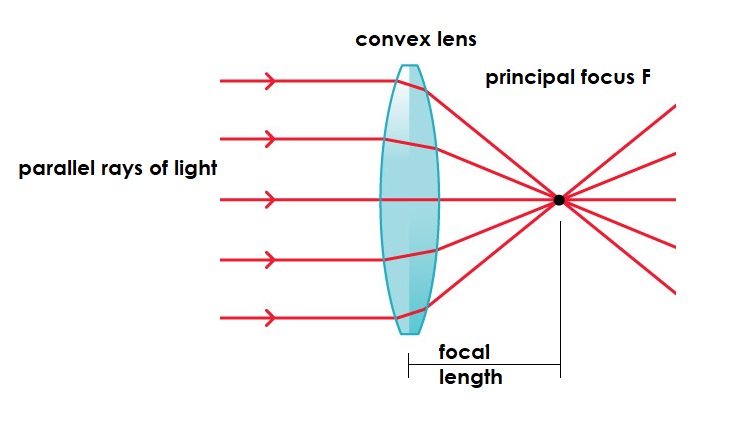
|
| What is another name for a convex lens? | a converging lens |
| State a practical example of a convex lens being used. |
• a magnifying glass to enlarge an image • a camera to form a clear image of a distant object |
| How does a concave lens affect parallel rays? | it makes parallel rays diverge such that the rays appear to be coming from a point on the same side of the lens as the parallel rays |
| Sketch a diagram of parallel rays of light passing through a concave lens. |

|
| What is another name for a concave lens? | a diverging lens |
| State a practical use of a concave lens. | a concave lens is used to correct short sight |
| What is the focal length? | the distance from the centre of the lens to the principal focus |
| x | x |
| x | x |
| x | x |
| x | x |
| x | x |
| x | x |
| x | x |
| x | x |
| x | x |
| x | x |
| x | x |
| x | x |
| x | x |
| x | x |
| x | x |
| x | x |
| x | x |
| x | x |
| x |
• • • • • |
| x |
• • • • • |
| x |
• • • • • |
| x | x |
| x | x |
| x | x |
| x | x |
| x | x |
| x |
• • • • • |
| x |
• • • • • |
| x |
• • • • • |
| x |
• • • • • |
| x |
• • • • • |
| x |
• • • • • |
| Question | Answer |
|---|---|
| x | x |
| x | x |
| x | x |
| x | x |
| x | x |
| x | x |
| x | x |
| x | x |
| x | x |
| x | x |
| x | x |
| x | x |
| x | x |
| x | x |
| x | x |
| x | x |
| x | x |
| x | x |
| x | x |
| x | x |
| x | x |
| x | x |
| x |
• • • • • |
| x |
• • • • • |
| x |
• • • • • |
A good tutor can build the confidence of a learner enabling subject success
A private tutor can improve the skills a pupil needs to master a subject
Regular tutoring can drive progress and better results in school subjects
Support can help students and parents make the right academic decisions