
KS Learning can provide extra lessons for maths from gcse maths tutors in London and help with gcse maths past papers, gcse maths revision notes, and gcse maths revision worksheets. Maths private tuition at its tuition centre can improve maths knowledge and performance through maths lessons, mathematics tutorials and maths tuition Twickenham.
| Question | Answer |
|---|---|
| Describe the structure of a magnetic compass. | a tiny magnetic needle pivoted at ts centre |
| How does a magnetic compass work? | one end of the needle points north and the other points south because of the earth's magnetic field |
| What is the end of a bar magnet called that points north? | it is called the north-seeking pole or the north pole for short |
| What is the end of a bar magnet called that points south? | it is called the south-seeking pole or the south pole for short |
| State the rule of magnets. | like poles repel and unlike poles attract |
| What materials can be magnetised? | a small number of metals including iron, cobalt, and nickel |
| What is steel? | iron with carbon and other elements added |
| What material is used to make permanent magnets? | steel |
| Why is steel used to make permanent magnets instead of iron? | steel does not lose its magnetism easily but iron does |
| Describe a practical way to show the magnetic field lines around a magnet. |
• place a sheet of paper over a bar magnet • sprinle iron filings on the paper • the filings form a pattern of lines called the magnetic field lines |
| What happens to a magnetic material placed in a magnetic field? | it experiences a force caused by the magnet |
| What is another name for magnetic field lines? | lines of force |
| What does the distance between the field lines indicate? | the strength of the magnetic field |
| Where are magnetic field lines closest? | at the poles |
| Where is the magnetic field strongest? | at the poles |
| Sketch the field lines around a bar magnet. |
the magnetic field lines of a bar magnetic start at the N-pole and curve around the magnet to the S-pole
|
| What will a compass do when placed in a magnetic field? | the needle of the compass aligns itself along a magnetic field line pointing in a direction away from the N-pole |
| What is the direction of magnetic field lines? | from North to South |
| How can an unmagnetised magnetic material be magnetised? | by placing it in a magnetic field for a period of time |
| What is induced magnetism? | it is magnetism created in an unmagnetised magnetic material when tha material is placed in a magnetic field |
| Will a permanent magnet stay magnetic forever? | permanent magnets lose about 1 per cent of their magnetism every 10 years |
| Can a permanent magnet be made demagnitised? | yes by striking or heating the magnet |
| Question | Answer |
|---|---|
| What is set up around a wire with a current in it? | a magnetic field |
| What is the shape of the magnetic field around a wire with a current in it? | it forms a series of concentric circles with the wire as the centre of the circle |
| How can you show the shape of the magnetic field around a wire with a current in it? |
• pass the wire through a flat surface like a sheet of cardboard • move a plotting compass around the wire on the surface marking the path it directs by the north arrow |
| What is the angle between the plane of the magnetic field and the current carrying wire? | it is at right angles |
| What rule can be used to work out the direction of the magnetic field around a current carrying wire? | the corkscrew rule or right hand rule |
| Describe the right hand rule. | the thumb points in the direction of the conventional current and the fingers curling around the wire show the direction |
| What happens to the direction of the magnetic field if the direction of the current is reversed? | the direction of the magnetic field is reversed |
| What is a solenoid? | a long coil of insulated wire |
| What is a benefit of a solenoid? | it produces a strong magnetic field when a current is passed through the wire |
| Name the factors that affect the magnetic strength of a solenoid. |
• an increase in turns, increases the magnetic strength of the solenoid • an increase in current, increases the magnetic strength of the solenoid |
| Where is the magnetism in a solenoid? | inside and outside the solenoid |
| Describe the magnetic field in a solenoid. |
• it strong and uniform • the magnetic field lines run parallel to the axis |
| Describe the magnetic field outside a solenoid. |
• the magnetic field lines bend around from one end of the solenoid to the other of the solenoid • the magnetic field outside the magnet is like that of a bar magnet • each field line is a complete loop running through the inside then the outside and then back in |
| Which side of the solenoid is north and which is south? |
• the current runs clockwise in the South end • the current runs counter clockwise in the North end |
| What is an electromagnetic? | a solenoid wrapped around a an iron bar |
| What is the iron bar in an electromagnet called? | the core |
| How does an electromagnet work? | when current runs through the solenoid is creates a magnetic field and the magnetic field magnetises the iron bar |
| What happens to an electomagnetic when the current is turned off? | it loses its magnetism |
| Question | Answer |
|---|---|
| List 4 devices using electromagnets. |
• the scrapyard crane • a circuit breaker • the electric bell • the relay |
| How does the scrapyard crane work? |
• scrap vehicles are lifted in a scrapyard using a powerful electromagnet • the steel magnet is lowered onto the vehicle with the current turned on • the vehicle sticks to the magnet and is lifted by the crane • the crane moves to where the vehicle is wanted • the current in the electromagnetic is turned off so that it is no longer a magnet, and the vehicle falls to the ground |
| How does a circuit breaker work? |
• a circuit breaker is a switch in series with an electromagnet • the switch is held closed by a spring • when the current is large, the electromagnet pulls the switch open • the circuit is broken • the switch remains open until it is reset manually |
| Sketch and label an electric bell. |
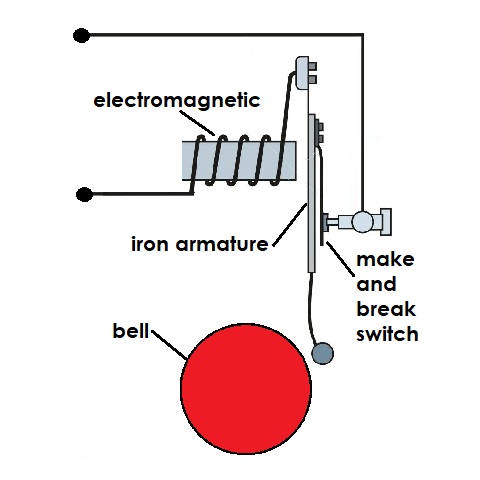
|
| Describe how an electric bell works? |
• when the circuit is connected to a battery, the armature is pulled on to the electromagnetic • the bell is struck • the make-and-break switch opens • the electromagnetic is switched off • the make-and-break switch returns to its original position • the circuit is closed • the cycle is repeated |
| What is a relay used for | to switch an electrical machine with a large current on or off with a small current |
| Sketch and label a relay. |
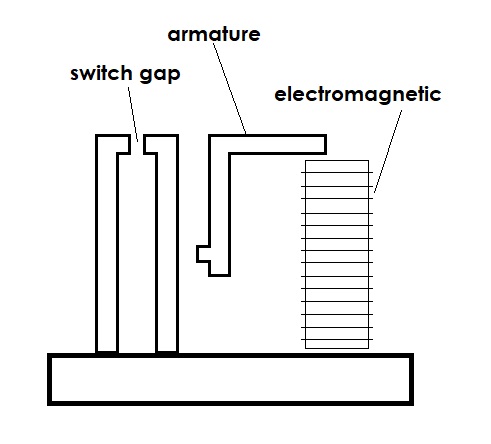
|
| Describe how a relay works |
• a small current passes through the coil of the electromagnet • the electromagnet turns on • the armature is pulled onto the electromagnet • the switch gap is closed • the machine is switched on |
| Question | Answer |
|---|---|
| List 4 electrical appliances that use an electrical motor. |
• a hairdryer • an electric shaver • a refrigerator pump • a computer hard drive |
| What is the motor effect? | a force acts on a wire when a current passes through the wire and the wire is placed in a magnetic field |
| How can the force be increased in the motor effect? |
• increasing the current • using a stronger magnet |
| What does the size of the force depend on in the motor effect? | the angle between the wire and the magnetic field lines |
| How does the size of the force depend on the angle between the wire and the magnetic field lines in the motor effect? |
• the force is greatest when the wire is perpendicular to the magnetic field lines • the force is zero when the wire is parallel to the magnetic field lines |
| What is the relationship between the direction of the force and the wire and magnetic field lines? | the force is always perpendicular to both the wire and the magnetic field lines |
| How can the force in the motor effect be reversed? | either • reverse the direction of the current • reverse the direction of the magnetic field lines |
| What is Fleming's left hand rule? | it can be used to work out the direction of the force by holding the thumb, first and second fingers at right angles, when • the thumb represents the direction of movement • the first finger represents the direction of the current • the second finger represents the direction of the magnetic field |
| What are the units of force, F? | Newtons, N |
| What are the units of current, I? | Amperes, A |
| What are the units of length, l? | metres, m |
| What is magnetic flux density, B? | a measure of the strength of a magnetic field |
| What are the units for magnetic flux density, B? | tesla, T |
| Write the equation for the force in the motor effect? | force, F = magnetic flux density, B x current, I x length, l |
| What device is designed to use the motor effect? | the electric motor |
| How do you change the speed of a motor? | increasing the current, increases the speed of the motor, and vice versa |
| Hod do you change the direction of the motor | reversing the direction of the current will reverse the direction of the motor |
| Describe the structure of the basic electric motor. |
• a rectangular coil of insulated wire known as the armature • the armature is attached to a ring split into two halves known as the split-ring commutator • the armature is connected to the battery by two metal or graphite brushes placed on the split-ring commutator • the armature is placed in a magnetic field 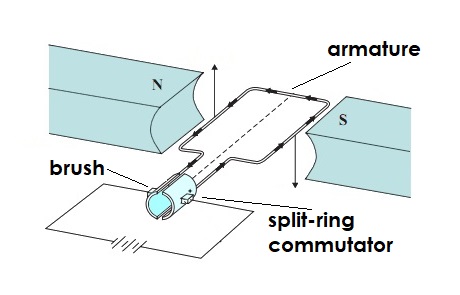
|
| Why is graphite used for the brushes in an electric motor? | graphite is a form of carbon that conducts electricity and is very slippery causing very litte friction |
| How does the electic motor work? | when a current is passed through the coil, the coil spins because • a force acts on each side of the coil dure to the motor effect • the force on one side is in the opposite direction to the force on the other side |
| What does the split-ring commutator do? | it reverses the crrent around the coil every half-turn of the coil |
| Why is a split-ring commutator needed in an electric motore? | the sides swap over each half-turn so if the current direction is not reversed the armature would turn back in the direction it came |
| Question | Answer |
|---|---|
| Why do hospitals have their own generators? | patient's lives would be put at risk without a standby generator |
| What does a generator do? |
• a generator contains coils of wire that spin in a magnetic field • a potential difference is created in the wire of the generator |
| What is the processs of creating a potential difference called? | electromagnetic induction |
| What is the generator effect? | a potential difference will be induced in a conductor passed through a magnetic field |
| How can the induced potential difference of the generator effect be increased? |
• by increasing the strength of the magnetic field • by moving the conductor faster through the magnetic field |
| Given a coil of wire, what potential difference will be induced when a bar magnetic is moved into and out of the coil? |
• when the bar magnet is moved into the coil, a potential difference will be induced • when the bar magnet is moved out the coil, a potential difference of the opposite polarity will be induced |
| What happens when the coil is moved and not the magnet? | a potential difference is induced if either the magnet or the coil is moved - it makes no difference |
| What does the induced potential and/or current generate when a magnet is moved in and out a coil? | it generates a magnetic field around the coil |
| What is the relationship between the magnetic field of the bar magnet and the induced magnetic field of the induced potential difference? | the induced magnetic field of the induced potential opposes the original change that caused it |
| What happens when the bar magnet stops moving? | the induced potential difference disappears i.e. falls to zero |
| What is the generated electricity the result of? | the work done in moving the magnet or the coil |
| How can a stationary direct-current electromagnet be used to induce a potential difference in a wire? | by turning the current on and off |
| Question | Answer |
|---|---|
| What is an alternator? | an alternating current generator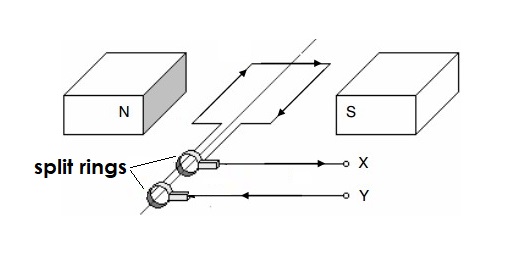
|
| Describe an alternating current generator. |
• a rectangular coil • that spins • in a uniform magnetic field • connected to two metal slip rings |
| What is the purpose of the slip rings? | they provide a continuous connection between the coil and the circuit |
| What will a meter show when connected to an alternating current generator in which the coil turns steadily in one direction? | the meter pointer deflects first one way then the other, and so on for as long as the coil keeps turning in the same direction |
| Why does the pointer of the meter behave like this? | because the induced current (or potential difference in an open circuit) first flows one way then the other (the current keeps changing direction) i.e. the generator produce an alternating current (or an alternating potential difference) |
| What is meant by alternating current? | the current keeps changing direction |
| Sketch the induced potential difference with time as the coil rotates? |
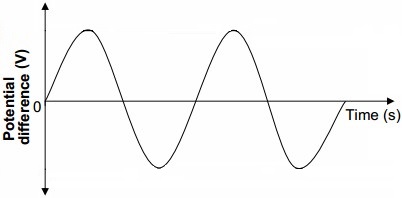
|
| What are the positive and negative maximum values called on the sine wave produced by an alternating generator? | the peak values |
| When does the induced potential in an alternating generator reach its peak values? | when the plane of the coil is parallel to the direction of the magnetic field so that the sides of the coil cross directly through the magnetic field lines |
| When is the induced potential difference in an alternating generator zero? | when the plane of the coil is perpendicular to the magnetic field so that the sides of the coil cross directly through the magnetic field lines |
| What is the effect of the speed of the coil in an alternating generator on the induced potential difference? | the faster the speed of the coil • the higher the frequency of the induced potential difference (pd) • the bigger the peak value of the induced potential difference (pd) |
| Why does the frequency of the induced pd increase as the coil's speed increases? | because each full cycle of the alternating potential difference takes the same time as one full rotation of the coil |
| Why does the peak value of the induced pd increase as the coil's speed increases? | because the sides of the coild move faster and so they cross through the magnetic field lines at a faster rate |
| How can the peak value of the induced pd be increased? |
• increasing the speed of the coil • increasing the strength of the magnet • increasing the number of coils of wire on the coil |
| What laboratory equipment can be used to show the pd produced? | an oscilloscope |
| What is a dynamo? | a direct current (DC) generator |
| How does a dynamo differ from an alternator? | the dynamo has a split-ring commutator instead of two separate slip rings |
| Describe what happens as the coil spins. | the split-ring commutator reconnects the coil the opposite way around in the circuit every half-turn |
| What is the position of the coil when the split-ring commutator switches the connection? | the coil is perpendicular to the magnetic field lines |
| Sketch the pd output of the dc dynamo. |
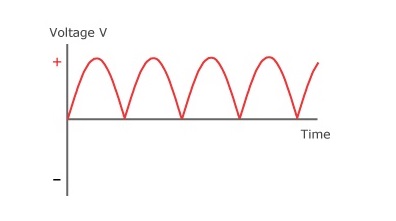
|
| What is the pattern of the induced pd in a dynamo? | it varies from zero to peak twice each cycle, never changing polarity |
| What does the moving coil microphone do? | it converts sound into electrical signals |
| Describe the structure of a moving coil microphone. | a diaphragm is attached to a coil which is placed between and around magnets
|
| How does the moving coil microphone work? |
• the sound waves strike the diaphragm • the pressure variations of the sound waves make it vibrate • the coil vibrates because it is attached to the diaphragm • the coil vibrates in the magnetic field • an potential difference is induced in the coil • the induced potential difference reflects the shape of the sound wave, in particular, its frequency |
| What does the moving coil loudspeaker do? | it converts electrical signals into sound |
| How does the moving coil loudspeaker work? |
• an electrical signal is applied to the coil • the current in the coil cause a force on the coil due to the motor effect • the moving coil vibrates the diaphragm • the diaphragm generates a sound |
| Question | Answer |
|---|---|
| What is the pd of mains voltage? | 230 V |
| Name the device that is used to change mains voltage to run or charge household devices. | a transformer |
| What is a step-up transformer used to do? | to increase the size of an alternating potential difference |
| What is a step-down transformer used to do? | to decrease the size of an alternating potential difference |
| What type of transformer is used at a power station to distribute on the National Grid? | a step-up transformer changes are used to step pd up from 25kV to 132kV usually |
| What type of transformer is used to supply electicity from the National Grid to homes? | a step-down transformer steps pd down to 230V for use in homes |
| Describe the structure of a transformer. | two coils of insulated wire, both wound around the same iron coil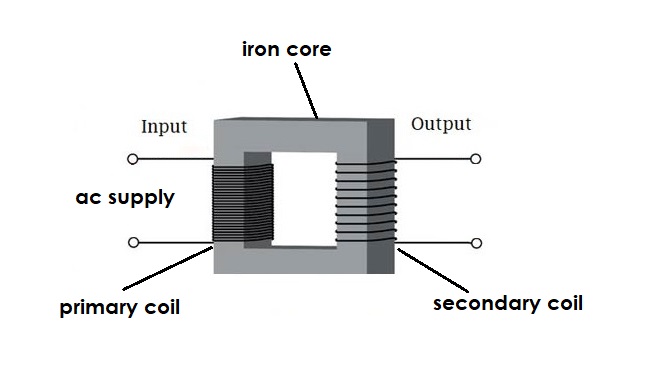
|
| Why is iron used for the core? | because iron is easily magnetised and demagnetised |
| What is the primary coil used for? | it is used as the input to the transformer which must be an ac input |
| What is the secondary coil used for? | the induced ac voltage that is supplied to the circuit that needs it |
| How does a transformer work? |
• the ac in the primary coil generates an alernating magnetic field in the iron core • the lines of the alternating magnetic field in the iron core pass through the secondary coil • the magnetic field in the secondary coil induces an alternating potential difference between the terminals of the secondary coil |
| Are the coils in the transformer electrically connected? | no, energy is transferred from the primary to the secondary via the magnetic field |
| What is the output of a transformers with a dc input? | there is no changing magnetic field with a dc input so the output is zero |
| How is the core constructed? | iron plates are glued together |
| What is the role of the core? | it guides the field lines in a loop from the primary to the secondary coil |
| Question | Answer |
|---|---|
| How does the number of turns in each coil compare in a step-up transformer? | there are more turns in the secondary coil than in the primary coil |
| How does the number of turns in each coil compare in a step-down transformer? | there are more turns in the primary coil than in the secondary coil |
| What does the secondary potential depend on? |
• the primary potential difference • the number of turns in each coil |
| State the transformer equation |
\( \frac {potential\; difference\; across\; primary\; coil\; Vp}{potential\; difference\; across\; secondary\; coil\; Vs} =
\frac {number\; of\; turns\; on\; primary\; coil\; np}{number\; of\; turns\; on\; secondary\; coil\; ns} \) \( \frac {Vp}{Vs} = \frac {np}{ns} \) |
| What is the relationship between ns and np in a step-up transformer? | in a step-up transformer ns is greater than np so Vs is greater than Vp |
| What is the relationship between ns and np in a step-down transformer? | in a step-down transformer ns is less than np so Vs is less than Vp |
| What is the usual efficiency of transformers? | most modern transformers are close to 100% efficient |
| What does it mean to say that modern transformers are almost 100% efficient? | almost all the electrical power supplied to the transformer is delivered to the device |
| Assuming 100% efficiency, state the equation relating current and voltage in a transformer |
\( {primary\; potential\; difference\; Vp} \times {primary\; current\; Ip} = \) \( {secondary\; potential\; difference\; Vs} \times {secondary\; current\; Is} \) \( {Vp \times Ip = Vs \times Is} \) |
| How is the heating effect in a resistor related to current? | the heating effect is proportional to the square of the current |
| Why is the grid potential increased in the National Grid? |
• the national grid aims to deliver a fixed amount of power • reducing the current, reduces power loss due to heating • increasing the potential difference maintains the power delivered as power = V x I |
| How is power calculated? | potential difference V times current I |
| How must current change if potential difference is tripled to deliver the same power | current must be reduced to a third |
A good tutor can build the confidence of a learner enabling subject success
A private tutor can improve the skills a pupil needs to master a subject
Regular tutoring can drive progress and better results in school subjects
Support can help students and parents make the right academic decisions